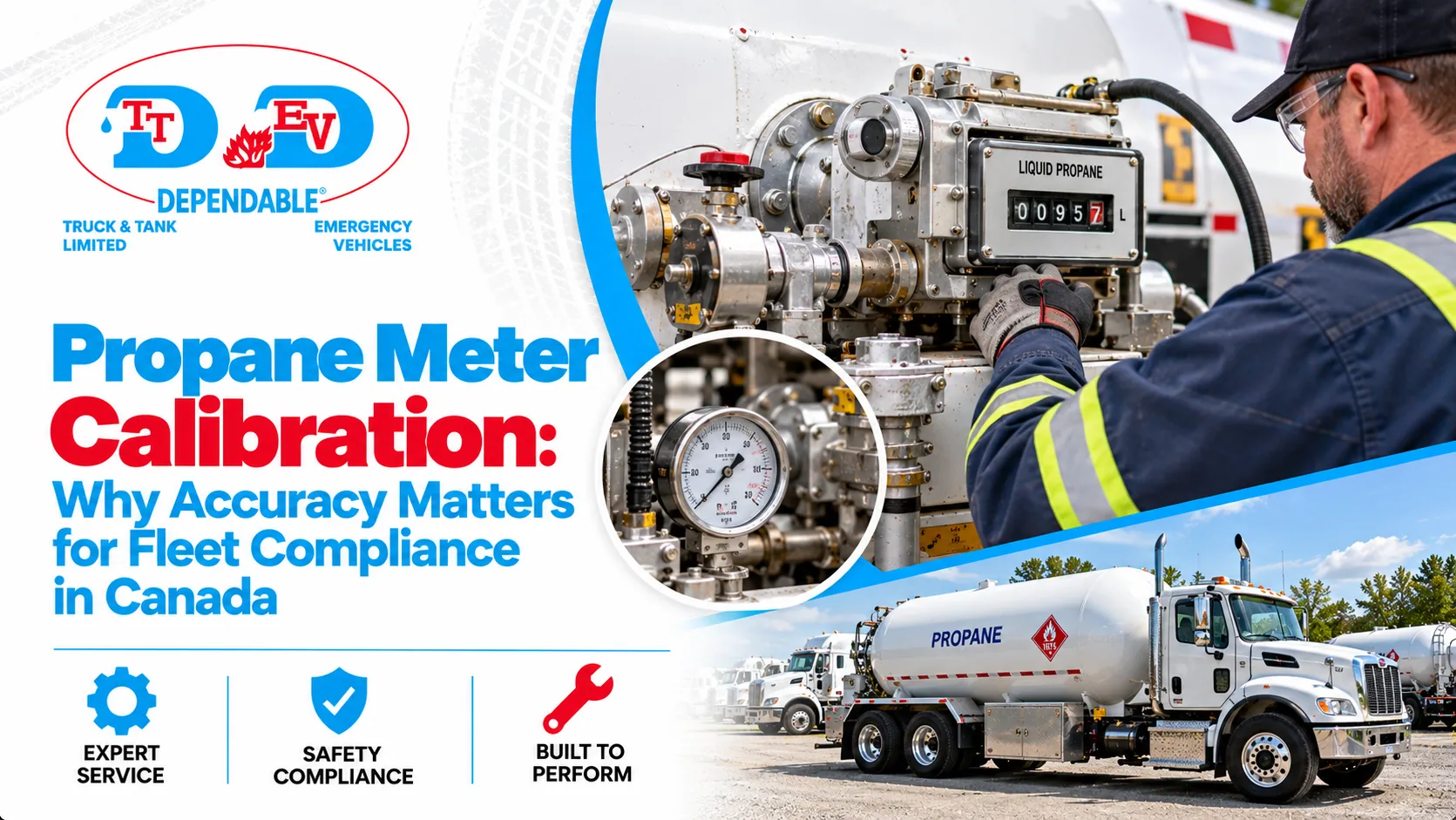
The meter on the side of your bobtail is a cash register. Every delivery you make is a sale priced on what that meter says, and nobody on either side of the hose can check the number by eye. Your customer trusts it. You bill from it. Federal law treats it as a trade device.
That is why flow meter calibration is not shop housekeeping. A meter that drifts half a percent light gives away product on every drop you make. A meter that drifts half a percent heavy overcharges customers, which is the version that brings penalties. Either way, you will not notice from the cab.
Professional propane meter calibration services exist precisely to catch that drift before it shows up on an invoice or an inspector’s report. A technician running a proper proving check can confirm in minutes what a driver could never spot over weeks of deliveries, and that confirmation is what keeps your billing defensible and your fleet compliant.
Meter accuracy in Canada has its own regulator, its own schedule, and its own penalties, all separate from the rules that cover your tank.
Your Meter Has Its Own Regulator
Plenty of operators assume one set of rules covers the whole truck. The dangerous goods rules that govern your tank say nothing about what your meter does. Measuring devices used in trade fall under the Weights and Measures Act, and Measurement Canada administers it as part of Innovation, Science and Economic Development Canada.
Two different regulators, two different schedules, two different sets of paperwork, on the same truck. A unit can be perfectly current on its tank testing and still be operating an overdue meter.
Measurement Canada does not perform the mandatory examinations itself. That work is done by Authorized Service Providers, which are accredited or registered by Measurement Canada to inspect and certify devices. If you are wondering whether your shop can sign off on a meter, that is the status to ask about.
How Often Your Propane Meter Has to Be Examined
Measuring devices in eight trade sectors carry mandatory examination frequencies. Two of those sectors matter to propane operators, and the interval is not the same in each.
- Retail petroleum. A propane meter used in retail trade has to be examined every year. This is shorter than the two-year interval that applies to most other devices in that sector, so it is easy to get wrong by assuming propane follows the same clock as diesel.
- Downstream petroleum. Devices used in bulk production or distribution of propane are on a two-year cycle.
Measurement Canada sets out the full picture of when your device has to be examined by sector and device type. Two details there are worth committing to memory. If a device is used in more than one trade sector, the earliest due date is the one that applies. And your next due date is printed on the examination certificate and on the sticker, so you never have to guess.
What Happens When You Run Past the Date
Measurement Canada monitors the marketplace and issues notices to owners whose devices are overdue. Once you receive one, you have 14 days to get the device examined by an Authorized Service Provider before further enforcement follows.
The financial side is not trivial. Businesses that do not comply can face monetary penalties of up to $2,000, and court-imposed fines reach $10,000 for minor offences, $25,000 for major offences, and higher again for repeat offences. Measurement Canada publishes the details in its guidance on compliance and enforcement for weighing and measuring devices.
Set against that, the cost of keeping to schedule is small and predictable. This is one of the cheapest compliance problems to avoid and one of the more expensive ones to ignore.
What Actually Happens During Calibration
Understanding the process helps you plan around it. Meter calibration services involve more than a technician turning a screw.
Proving the Meter
Meter proving is the heart of it. The technician runs a known volume of product through the meter under normal operating conditions and compares what the meter registered against what actually passed through, using a calibrated prover or test measure. Doing it at realistic flow rates matters, because a meter can read accurately at one rate and drift at another.
Adjustment and the Seal
If the meter is outside the limits of error, the calibration is adjusted and corrected. Those adjustments sit behind a meter seal precisely so they cannot be changed quietly. Seals are checked before work begins, and new ones are applied afterward.
This is the part fleet owners most often get caught out by. Anyone who adjusts, alters, or repairs a trade device in a way that may affect its accuracy has to report it to Measurement Canada within five days, including details of any seal broken and any seal fitted to replace it. The requirement sits in the Weights and Measures Regulations. A broken seal is never just a broken seal.
Temperature Compensation
Propane expands and contracts more than most liquids you haul. A litre loaded on a cold morning is not a litre delivered on a warm afternoon. Many propane meters use automatic temperature compensation to correct measured volume to a standard reference temperature, which in Canada is 15 degrees Celsius. If that system is faulty, your meter can pass a basic accuracy check and still bill wrong across a season. It needs to be verified along with everything else.
There is a simple check you can do yourself. A meter with temperature compensation should be able to show two numbers. One is the corrected volume you bill from. The other is the raw volume before correction, which an inspector can ask to see. If your display cannot show the raw number, raise it with your service provider before an inspector raises it with you.
Where Accuracy Quietly Costs You
Run the arithmetic on your own volumes. A bobtail delivering a few thousand litres a day, off by half a percent, is giving away or overcharging tens of thousands of litres a year. Neither outcome is one you want to find out about late.
Worn meter internals, a sticking differential valve, a failing temperature probe, and air in the lines all pull measurement off in ways the driver cannot see. This is why meter calibration earns its place in preventive maintenance rather than sitting on a separate compliance list. It protects margin as much as it protects your record.
It also connects to the rest of the truck. A meter reads what the pump sends it, so pump repair issues show up as measurement problems. Worn hoses, fittings, valves, and nozzles affect delivery too, and having the right fuel delivery equipment parts available means a fault found on the day does not turn into a week off the road. Our fuel delivery equipment range covers the components that go with the meter.
Pairing Meter Work With Your Tank Schedule
The smartest thing you can do with two regulators is stop treating them as two trips. When a unit is already in the shop for its CSA B620 tank inspection, the meter can be proved and certified in the same visit rather than pulling the truck off the road twice.
That is how we handle propane tanker truck services here. Meter work and CSA B620 inspections run out of the same shop, so a unit can leave with both sets of paperwork current.
Booking propane meter calibration at the same time as your tank inspection and testing services gives you one appointment to plan around instead of two. The same applies to every propane tanker truck in your fleet.
Choosing where to get this done matters as much as remembering to do it. Not every shop that touches propane equipment is set up to provide propane meter calibration services to Measurement Canada’s standard, so ask whether the technician proving your meter is working under an Authorized Service Provider registration before you book. A proper visit should also leave you with paperwork you can produce on demand: a dated certificate, the meter’s new seal number, and a record of what was adjusted, so you are never scrambling to prove compliance when an inspector or a customer asks.
Keep the Cash Register Honest
Accurate measurement protects three things at once. It protects your margin, it protects your customers, and it protects your standing with a regulator that monitors this actively. None of that requires much effort if the dates live on your calendar instead of in a folder.
Building a relationship with one provider for propane meter calibration services also pays off over time. A technician who has worked on your units before already knows your meter models, your typical flow rates, and your past readings, which makes every return visit faster and any drift easier to spot early.
Dependable NS works on propane bobtails and fuel delivery units for fleets across Nova Scotia and Atlantic Canada. If you are unsure when your meters are next due, or you would rather handle meter and tank work in a single visit, get in touch and we will help you sort out the schedule.
Frequently Asked Questions
Who regulates propane meters in Canada?
Measurement Canada, under the Weights and Measures Act. This is entirely separate from the dangerous goods rules that govern the tank itself. Both apply to the same truck.
How often does my propane meter need to be examined?
Propane meters used in retail petroleum trade need examination every year. Devices used in bulk distribution fall under downstream petroleum and are on a two-year cycle. Your certificate and sticker show the next due date.
Can Measurement Canada inspect my meter for me?
Not for mandatory examinations. Those are carried out by Authorized Service Providers that Measurement Canada has accredited or registered. Measurement Canada handles enforcement.
What happens if my meter is overdue?
If you receive an overdue notice, you have 14 days to have the device examined before further enforcement. Penalties for non-compliance can reach thousands of dollars, with higher court-imposed fines for major or repeat offences.
Why is there a seal on the meter?
The seal covers the calibration adjustment so it cannot be altered without leaving evidence. If a seal is broken during repair or adjustment that could affect accuracy, that has to be reported to Measurement Canada within five days.
Does temperature really change my delivered volume?
Yes. Propane expands and contracts significantly with temperature, which is why measured volume is corrected to a reference temperature of 15 degrees Celsius. If the compensation system fails, your billing drifts even when the meter looks accurate.
Can meter work be done at the same time as tank testing?
In most cases, yes, and it is the efficient way to do it. Booking both together means one scheduled outage instead of two.