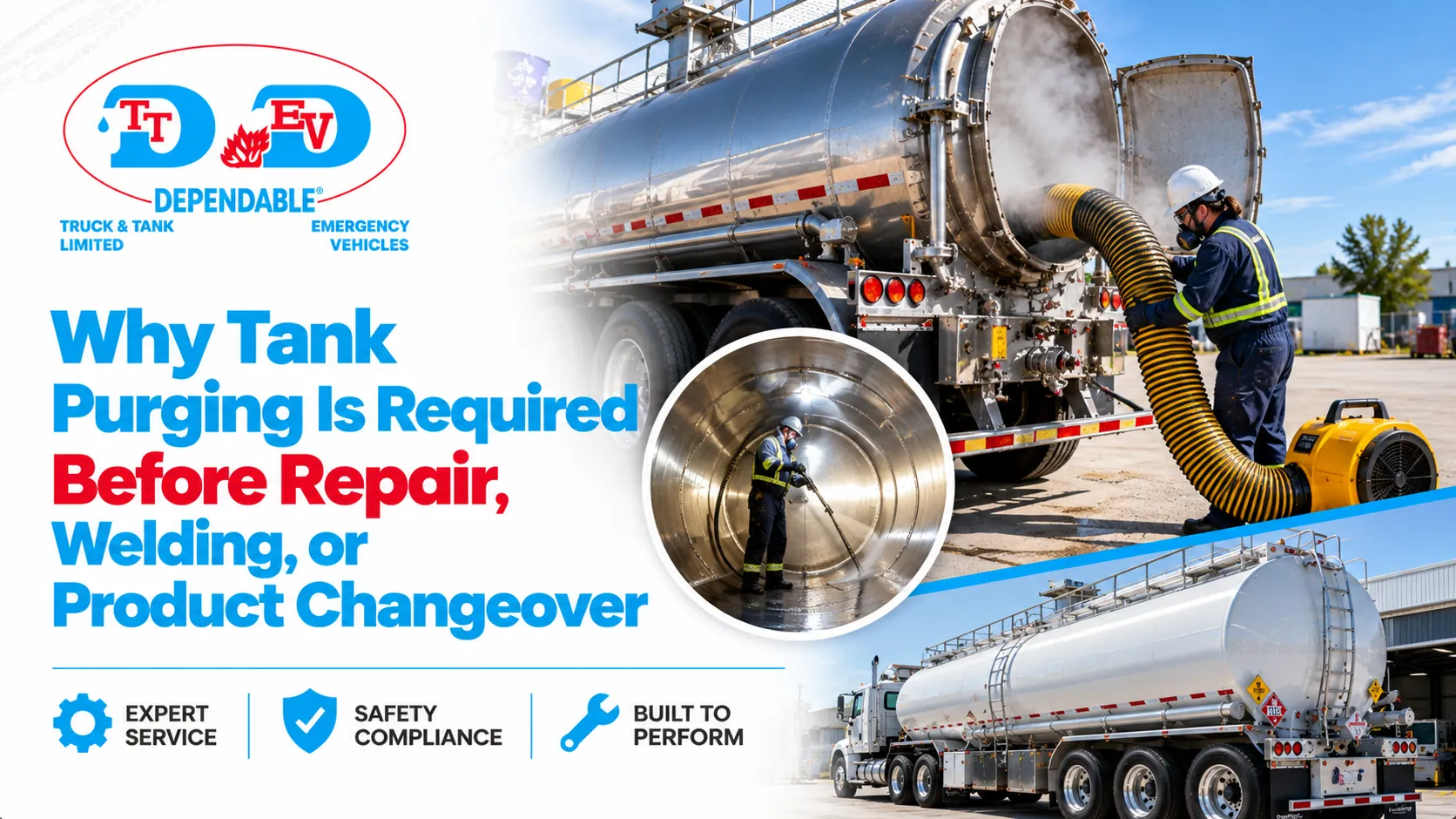
A tank that has been drained is not empty. What is left behind after the product goes out is a thin film on the walls, residue in the low points, and an atmosphere inside that can sit right in the range where a single spark sets it off. The tank looks empty from the outside. It is not.This is the reason tank purging before repair exists as a distinct job with its own process, its own documentation, and its own sign-off. It is not a step a shop adds to pad the invoice. It is the step that keeps a welding job from becoming a fatality. If you run fuel tankers, propane bobtails, or any unit that carries a flammable product, purging will shape your repair schedule more than you expect.
The Empty Tank Is the Dangerous One
A full tank of propane is not, on its own, an explosion risk. There is no oxygen inside it. A tank that has been drained and opened is a different matter, because now you have residue, air, and heat arriving together. That is the complete set of conditions a fire needs.
The Canadian Centre for Occupational Health and Safety puts it about as plainly as a safety body can. Its alert on welding on containers describes hot work on containers as one of the most dangerous operations in industry, warns that a worker doing it on an unprepared container is working on what amounts to an unexploded bomb, and states that many explosions and deaths have come from improper cleaning, purging, and testing. It also warns against ever assuming a container is clean.
Two details catch people out. Interior corrosion can generate hydrogen inside a sealed tank with no product present at all. And interior coatings and linings can give off hazardous fumes the moment heat touches them, even when the tank itself is spotless. Neither is visible when you look through the manhole.
Why Tank Purging Before Repair Is Never Optional
Purging removes the flammable atmosphere and replaces it with something that cannot burn. Until that has been done and verified by testing, no cutting, no grinding, and no welding can safely start.
This is why tank degassing before maintenance work is treated as a job in its own right rather than a few minutes of prep. The tank has to be emptied properly, lines isolated, residue removed, the atmosphere displaced, and the result confirmed with instruments before anyone brings a torch near it. Skipping ahead is how people get hurt.
The same logic applies to hazardous material tank cleaning and purging on units that carried something other than fuel. What was in the tank determines how it has to be cleaned, where the residue goes, and what the crew has to wear while they do it.
The Three Times Your Tank Needs It
Before Repair and Welding
Any hot work on a tank that held flammable product requires the tank to be made safe first. That covers a crack in a seam, a failed baffle weld, a fitting replacement, and a remount. When a shop quotes you weld repair and pressure vessel services, making the tank safe is part of that job and part of the timeline.
Before Internal Inspection or Entry
A cargo tank is a confined space, and under Nova Scotia’s occupational health and safety rules, that brings a set of requirements before anyone goes in. A competent person has to assess the space, test the atmosphere, and confirm oxygen sits within the permitted range and that chemical concentrations are below the limits set in the regulations. The province’s confined space guidance sets out what an employer has to do. In practice, your tank inspection and testing services cannot begin until the purge is finished and verified.
Before a Product Changeover
If a unit is moving from one product to another, residue from the old product has to come out before the new one goes in. Cross-contamination can ruin a customer’s load, damage seals and linings not rated for the new product, and in some combinations create a reaction hazard. A changeover is a cleaning job as much as a safety job.
What the Work Involves
You do not need to know how to do this yourself. You do need to know enough to recognise whether it is being done properly and why it takes the time it takes.
The tank is drained and isolated from its lines. Residue is removed by washing, steaming, or another method suited to the product. The atmosphere inside then has to be displaced, which is where nitrogen purging services come in. A nitrogen purging procedure pushes the flammable atmosphere out and replaces it with an inert gas that will not support combustion. Where the tank has to be entered afterward rather than only worked on from outside, the sequence changes again, because a nitrogen-filled tank is lethal to walk into.
A cargo tank vapor freeing procedure is the other side of the same problem, clearing the tank so the atmosphere inside is safe rather than simply inert. Which approach is correct depends on the product, the tank, and what is being done next. That decision belongs to a qualified technician, not to a checklist found online.
Throughout, the work is verified with gas detection instruments rather than judged by smell or appearance. Testing is not a formality at the end. It is how anyone knows the job worked. Our tank purging work follows the method the product and the tank call for.
Hot Work Permits and Who Signs Off
Hot work on a tank is permit-controlled work. Hot work permit requirements exist so that one identified person confirms the tank has been made safe, the atmosphere has been tested, fire watch is in place, and the work is authorised to start. The permit is the paper record that all of this happened in the right order.
Atmospheric testing has to be done by a competent person using properly calibrated instruments, and CCOHS sets out what is expected around confined space atmospheric testing across Canadian jurisdictions. If a shop cannot tell you who holds that role and how their instruments are calibrated, that is the answer to your question.
How It Fits With the Rest of the Work
Purging is rarely the reason a tank comes in. It is the gate that everything else has to pass through, which makes it worth scheduling around rather than discovering on the day.
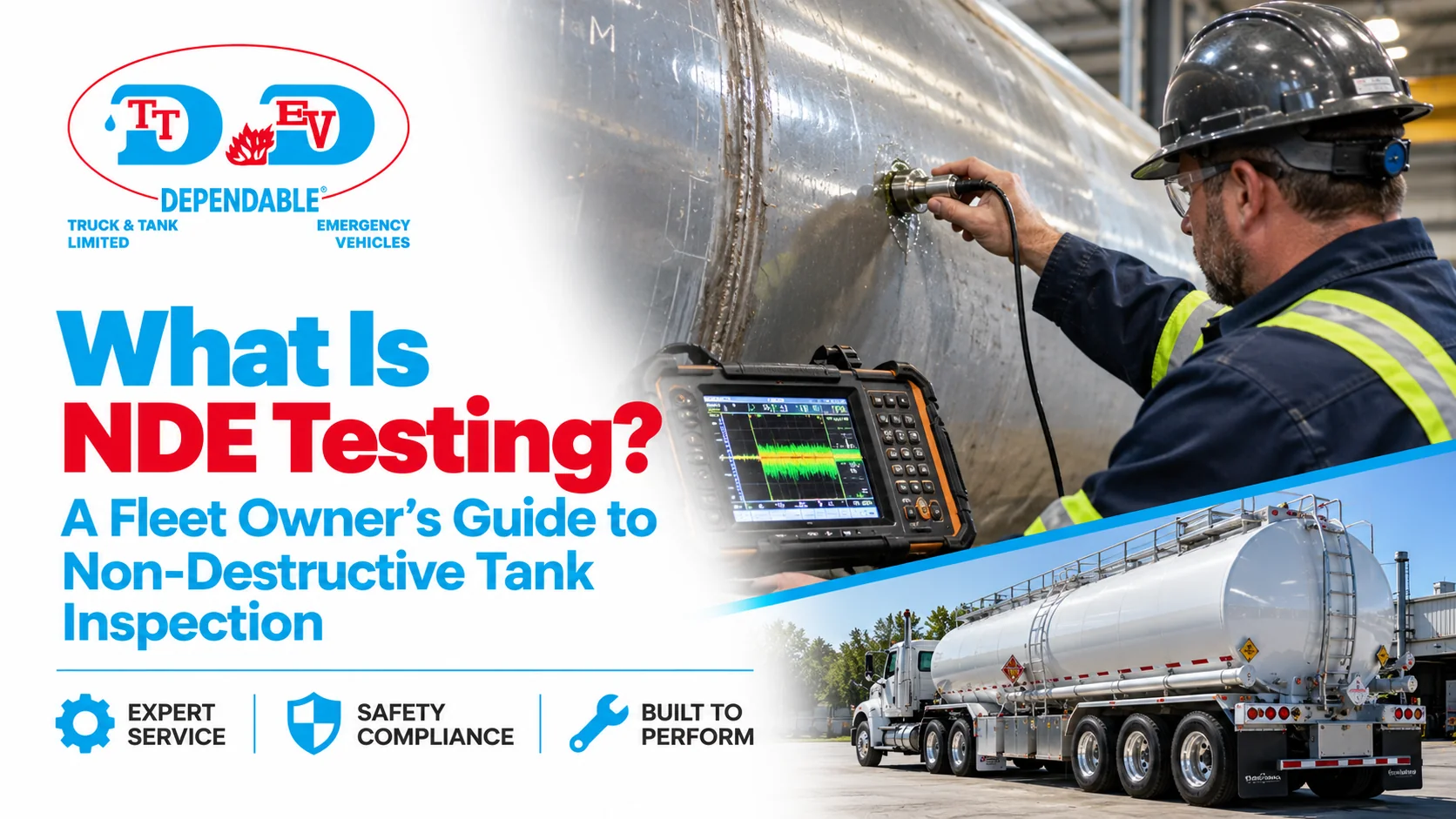
Once the tank is safe, the rest of the visit can run without interruption. NDE testing and non-destructive inspection can go ahead on the shell and the welds; findings can move straight into repair, and the unit can be recertified and put back to work. Booking tank purging services as part of the visit rather than as a separate errand is what keeps a two-day job from becoming a two-week one.
Purge, repair, and inspection all happen in the same shop here, so a unit does not move between facilities partway through a job. Fleets booking propane tanker truck repair services usually have all three handled in one scheduled outage, and tank repair picks up as soon as the tank is safe to work on.
Common Mistakes Fleet Owners Make
- Treating a drained tank as an empty tank. Residue and the atmosphere left behind are the hazard, not the product you already delivered.
- Not budgeting time for it. Purging adds hours or longer to a visit depending on the product and the tank. Plan the outage around the full job.
- Sending a unit in without saying what it last carried. The last product determines the method. Guessing costs time and can be unsafe.
- Asking for a quick weld on a tank that has not been made safe. A shop that agrees to this is telling you something important about how it works.
- Forgetting that an inert tank is not a safe tank to enter. Purged for hot work and safe for entry are two different conditions.
- Assuming a clean-looking tank needs less preparation. Corrosion products and interior linings create hazards that are invisible from the hatch.
What to Have Ready Before Your Unit Goes In
A short conversation before the truck arrives saves a day at the shop:
- Confirm the last product carried and how long the tank has been standing.
- Say whether the tank has an interior lining or coating, and what kind.
- List the work you want done, since hot work and internal entry have different requirements.
- Flag any known damage, past repairs, or areas already suspected of thinning.
- Mention whether a product changeover is planned, not just a repair.
- Ask what the expected turnaround is once purging is included.
- Ask for the documentation from the purge and testing to go in your records with the repair paperwork.
Make Safety the First Step, Not the Afterthought
Purging is the least visible part of a tank repair and the part that everything else depends on. It does not show up in the finished weld or on the inspection report, but the work could not have happened safely without it.
Dependable NS handles tank purging and vapor freeing services, cleaning, repair, and inspection for the propane tanker trucks and fuel units that come through the shop. If you have a repair coming up, a product change planned, or a unit due for internal inspection, get in touch early and we will tell you what the unit needs and how long to allow for it.
Frequently Asked Questions
Is a drained tank safe to weld on?
No. Draining removes the product but leaves residue and an atmosphere inside that can ignite. The tank has to be cleaned, purged, and tested before any hot work begins.
What is the difference between purging and vapour freeing?
Purging displaces the atmosphere inside the tank, commonly with an inert gas, so it cannot support combustion. Vapour freeing clears the tank so the atmosphere inside is safe rather than simply inert. Which one applies depends on the product and on what work comes next.
Why is nitrogen used?
Nitrogen does not support combustion, so filling the space with it removes one of the three things a fire needs. It is also why a nitrogen-filled tank is dangerous to enter, since there is no breathable oxygen inside.
How long does purging take?
It depends on the product, the size of the tank, and whether the unit is being entered afterward. Treat it as part of the repair timeline rather than a quick step at the start, and ask for an estimate when you book.
Do I need purging for a product changeover if there was no damage?
Usually yes. Residue from the previous product can contaminate the new load and can be incompatible with seals or linings. A changeover is a cleaning requirement even when nothing is broken.
Who is allowed to authorise hot work on my tank?
A competent person designated for that role, working to a permit, after the atmosphere has been tested with calibrated instruments. Ask your shop who holds that responsibility.
Can I have my tank purged somewhere and repaired somewhere else?
It is possible but rarely sensible. Moving a tank between the purge and the repair adds handling, cost, and time, and the receiving shop will want to verify the tank’s condition itself before starting work.