Most fleets do maintenance. Far fewer have a programme. The difference is whether work happens because a schedule called for it or because something broke, and it shows up in the same place every time: the number of trucks unavailable on any given morning.
There is a second reason to care. A preventive maintenance program for commercial trucks is not optional in this province. It is written into the regulations that govern every carrier operating here.
Searching for truck engine repair near me often means a fleet owner is already facing mechanical problems or unexpected downtime. Rather than waiting for an engine failure, regular inspections, diesel engine diagnostics, and scheduled maintenance can help detect potential issues early. A structured preventive maintenance program allows fleet operators to address engine problems before they become costly repairs, reduce unexpected breakdowns, and keep commercial trucks operating reliably across Nova Scotia.
The Legal Floor
Nova Scotia’s Commercial Vehicle Maintenance Standards Regulations require a carrier to set up a system of preventive vehicle inspection, maintenance, and repair for every truck and trailer it operates, and then to inspect, maintain, and repair each unit according to that system and to the performance standards in the regulations.
Read that again, because the wording matters. The obligation is not simply to keep trucks in good condition. It is to have a system, follow your own system, and be able to show both. A carrier with well-maintained trucks and no documented programme can still be offside.
The national framework behind this is National Safety Code Standard 11, which covers maintenance and periodic inspection and sets out what a vehicle file should contain.
The Records You Are Required to Keep
Record-keeping is where most audit findings come from, and the list is not long.
- Make, model year, plate number, serial number, and tire size for each vehicle.
- The name of the person or company leasing the vehicle to the carrier, where that applies.
- The nature and due date of every inspection and maintenance operation scheduled for that unit.
- The date and nature of every inspection, repair, lubrication, and maintenance operation performed, with the odometer reading, where applicable.
- A record of any axle or suspension modification affecting the gross vehicle or axle weight rating.
Retention has a clock too. Records are kept at the carrier’s principal place of business in Nova Scotia for two years, and for six months after a vehicle leaves the carrier’s control, subject to the applicable record-retention requirements. They have to be readily available to an inspector on request, and refusing access is itself an offence. Failing to bring a fleet maintenance program into line with the standard can affect the carrier’s profile and safety rating, which is the part that follows you around.
Building a Preventive Maintenance Program for Commercial Trucks
The regulation tells you to have a system without telling you what it looks like. In practice, a workable one has four parts.
Intervals that match the work
Start from manufacturer intervals, then adjust for how the unit is actually used. A truck on short urban runs accumulates engine hours and brake wear that distance alone understates. A unit that sits for weeks has its own problems. Time, distance, and hours are all valid triggers, and the right one depends on the vehicle.
Tiered service levels
Most fleets run a light service at short intervals, a fuller one less often, and a major service annually alongside the periodic mechanical inspection. Defining what belongs in each tier stops the light service quietly expanding and the major one getting skipped because it is inconvenient.
A route from defect to repair
Daily inspection reports are a data source, not filing. If the same unit shows the same minor defect three weeks running, that is your programme telling you something. Give reported defects somewhere to go and someone responsible for closing them out. A preventive maintenance checklist is only useful if what it finds reaches a technician.
Records kept as you go
Reconstructing a vehicle file before an audit is miserable and rarely convincing. Capturing the odometer reading and the nature of the work at the time takes seconds.
What Belongs in the Schedule
The systems below account for most unplanned downtime, and all of them give warning before they stop a truck.
Engine condition is the one worth catching early, since fault codes and fuel or coolant trends appear long before a failure. Regular diesel engine diagnostics turn that into information you can schedule around.
Brakes need attention on an interval rather than on complaint, because adjustment drifts and ABS faults are among the most common roadside findings. ABS and brake system services belong in every tier of the schedule at some level.
Front-end wear is gradual and expensive to ignore, since it destroys tires long before anything else announces itself. Putting suspension and steering repair on an interval usually costs less than the tires it saves.
Do Not Forget the Mounted Equipment
Driveline work tends to get postponed because the symptoms are tolerable for a long time. Fluid and service intervals for Allison transmission repair are worth following properly rather than by feel.
On specialised units, the mounted equipment needs its own line in the schedule. Hydraulic system repair is a common gap here, because hoses, cylinders, and pumps on a body get serviced only when they leak.
Making the Numbers Work
The argument for a programme is not safety alone, though that is reason enough. It is that planned work is cheaper per hour, scheduled at your convenience, and does not strand a truck and a load somewhere inconvenient.
Track two things, and the case makes itself. Count how many repairs in a quarter were planned versus unplanned, and record how many units were unavailable each morning. Fleets that start scheduling properly see both move within a few months, and the second one is what your dispatcher actually feels.
There is a size threshold worth naming. Below roughly ten units, most operations can run this on a spreadsheet and a calendar. Above that, tracking usually needs software, because the problem stops being bad decisions and becomes forgotten dates. Either way, fleet maintenance that lives in one person’s head is a single point of failure.
Common Mistakes Fleet Owners Make
- Having maintenance without a documented system. The regulation requires the system and the records, not just the outcome.
- Using distance as the only trigger. Hours and elapsed time matter for units that idle, work off-road, or sit.
- Letting daily inspection reports die in a folder. They are the cheapest early warning data you have.
- Skipping the specialised body. Pumps, hydraulics, and mounted equipment need scheduling like everything else.
- Deferring during busy periods. The deferral always costs more later, and usually at a worse moment.
- Reconstructing records before an audit. Records created after the fact rarely hold up and take longer than keeping them properly.
Your Starting Checklist
If you are building this from nothing, work in this order:
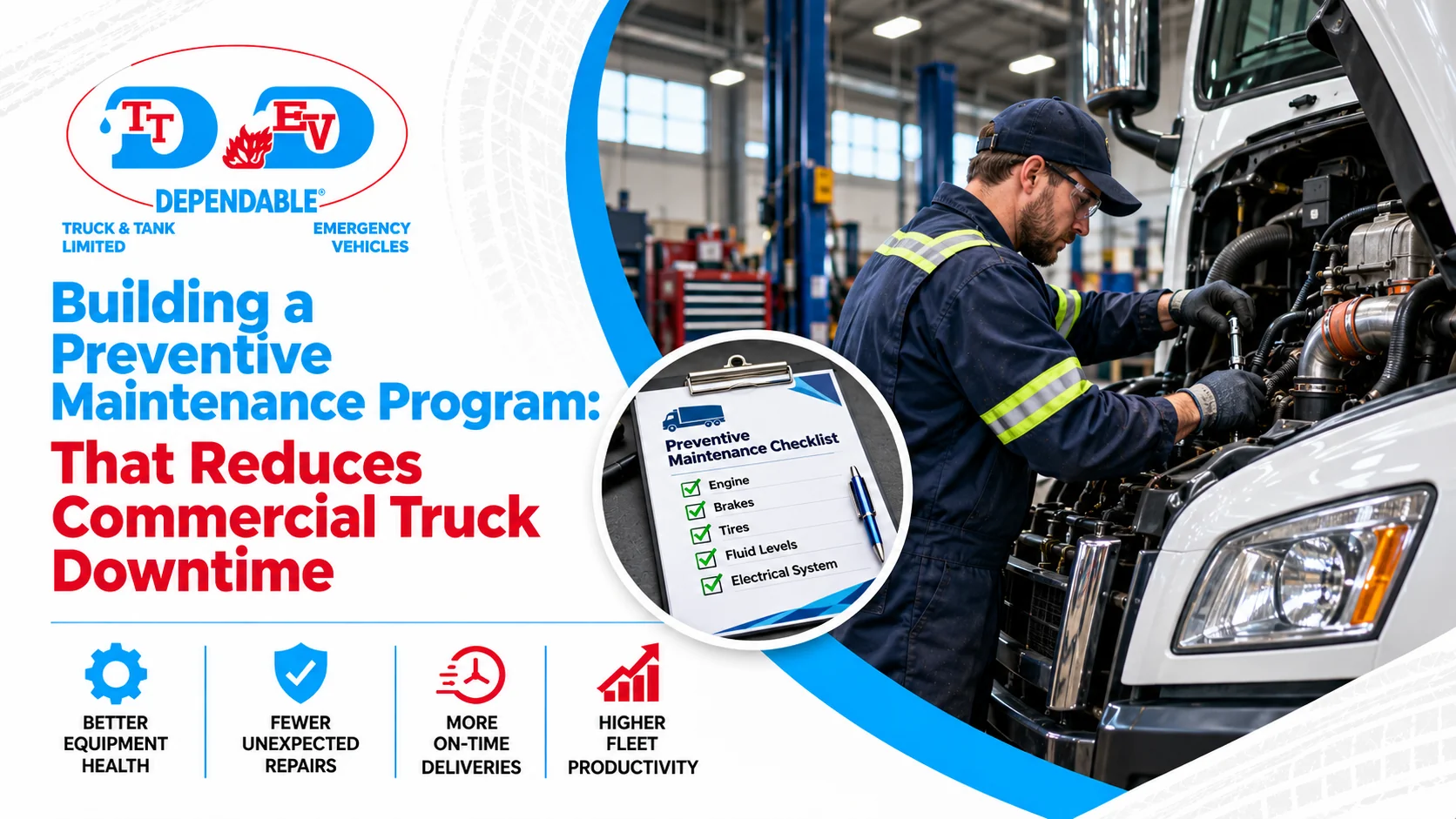
- List every unit with the identifying details the regulations require.
- Set intervals for each unit based on manufacturer guidance and actual duty cycle.
- Define what happens at each service tier so nothing depends on memory.
- Decide who reviews daily inspection reports and how defects reach the shop.
- Set up a vehicle file that captures date, nature of work, and odometer every time.
- Put periodic mechanical inspections and any dangerous goods inspections on the same calendar.
- Review the programme once a year against what actually failed.
Reduce Commercial Truck Downtime With Dependable NS
A well-planned preventive maintenance program helps reduce unexpected breakdowns, control repair costs, and keep your commercial fleet operating efficiently. Addressing recurring mechanical issues early and scheduling regular inspections can help prevent costly downtime and improve long-term fleet reliability.
At Dependable Truck & Tank Nova Scotia, we provide commercial fleet repair, preventive maintenance, and mechanical services for heavy-duty trucks and trailers across Nova Scotia and Atlantic Canada. From chassis repairs to mounted equipment maintenance, our experienced technicians help keep your fleet safe, compliant, and road-ready.
Keep your fleet moving and minimize unexpected downtime. Contact Dependable NS today to schedule fleet maintenance or discuss a preventive maintenance program tailored to your commercial vehicles.
Frequently Asked Questions
Is a preventive maintenance programme legally required in Nova Scotia?
Yes. The Commercial Vehicle Maintenance Standards Regulations require every carrier to set up a system of preventive inspection, maintenance, and repair for each truck and trailer it operates, and to follow it.
How long do maintenance records have to be kept?
Two years at the carrier’s principal place of business in Nova Scotia. For maintenance records, the regulations also specify six months after a vehicle leaves the carrier’s control. Different record categories may have additional retention rules.
What has to be in a vehicle file?
Identifying details for the unit, the lessor’s name where applicable, the nature and due date of scheduled work, a dated record of every inspection and repair with an odometer reading, and any axle or suspension modification affecting weight ratings.
What happens if my records are not in order?
Records must be readily available to an inspector on request. Shortfalls can affect the carrier profile and safety rating, with further sanctions possible if the programme is not brought into compliance.
Should intervals be based on distance or time?
Whichever reflects how the unit is used. Trucks that idle heavily or work off-road accumulate wear that distance alone understates, so engine hours or elapsed time are often the better trigger.
Does the programme cover mounted equipment as well as the chassis?
It should. Pumps, hydraulics, and bodies fail on their own schedule, and leaving them out is one of the most common gaps in otherwise solid programmes.
How often should a commercial truck be aligned?
There is no single interval. Book wheel alignment services when tires show uneven wear, after front-end components are replaced, and after any hard impact such as a deep pothole or a curb strike. Uneven tire wear is the signal most fleets act on too late.
What do drivetrain services cover?
Clutch, driveshaft, differentials, and axles, along with the fluid changes each of those needs. These parts tolerate wear for a long time before failing, which is why they get postponed and then fail somewhere inconvenient.