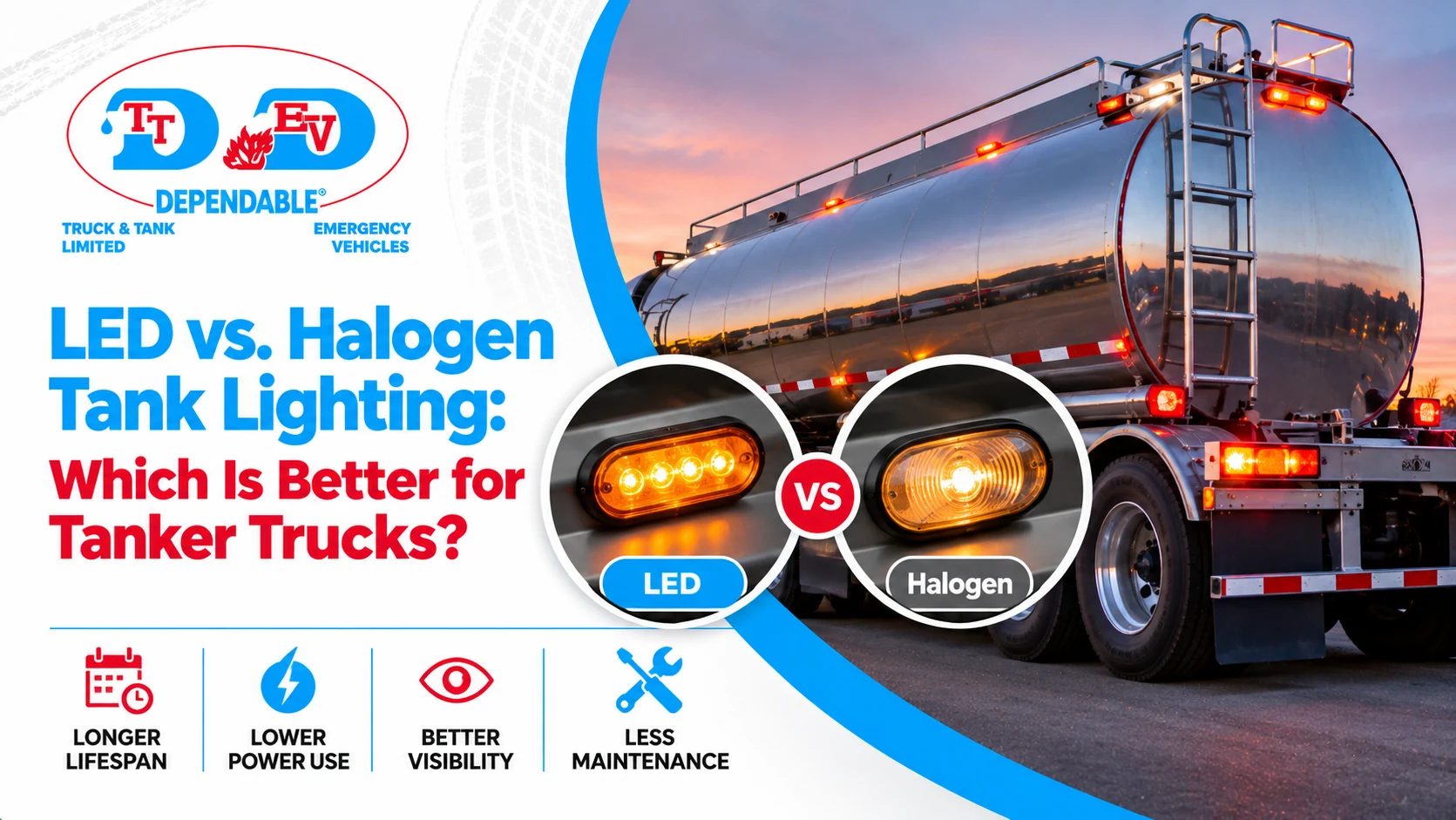
Tanker truck lighting plays a critical role in keeping tanker trucks visible, safe, and ready for the road. Whether transporting fuel, propane, water, or other liquid products, commercial tankers depend on reliable exterior lights to communicate braking, turning, vehicle width, and movement to surrounding motorists. Poor lighting can increase collision risks, complicate inspections, and create unexpected downtime
When comparing LED vs. incandescent trailer lights, fleet owners often focus on brightness and purchase price. However, the decision involves much more, including electrical efficiency, vibration resistance, maintenance requirements, weather protection, and long-term operating costs. Halogen lighting also enters the discussion because it remains common in certain truck headlamp and auxiliary lighting applications.
For tanker operators across Nova Scotia and Atlantic Canada, choosing the right truck lighting system can make a meaningful difference during nighttime deliveries, winter driving, and regular fleet inspections.
Quick Answer: Are LED lights better for tanker trucks?
LED lights are generally the better choice for most tanker truck exterior lighting applications because they consume less electricity, resist vibration better, and typically last longer than conventional incandescent or halogen bulbs. However, the correct choice depends on the lighting function, electrical compatibility, installation quality, and compliance with applicable Canadian standards. A properly maintained incandescent system can remain serviceable, while a poorly installed LED upgrade can still fail.
Understanding LED, Halogen and Incandescent Tanker Lighting
Before comparing different lighting technologies, it is important to understand how they operate and where they are commonly used.
What Are LED Trailer Lights?
Light-emitting diode (LED) technology produces light when electrical current passes through a semiconductor. Unlike traditional bulbs, LEDs do not rely on a heated filament to produce visible light.
Modern LED trailer lights are used for several commercial vehicle applications, including:
- Rear brake and tail lights
- Turn signals and hazard lights
- Side marker and identification lamps
- Clearance and width-indicating lights
- Licence plate illumination
- Reverse and auxiliary work lighting
Many commercial LED assemblies combine several functions into one sealed housing. This can simplify maintenance and reduce the number of exposed electrical connections when the assembly is properly designed and installed.
What Are Incandescent Trailer Lights?
Incandescent lights produce illumination by heating a tungsten filament inside a glass bulb.
Conventional incandescent bulbs have been used in commercial trailer lighting for decades because they are inexpensive, widely understood, and relatively simple to replace.
However, their filaments are vulnerable to vibration and repeated mechanical shocks. They also generate considerable heat and generally require more electrical power than equivalent LED assemblies.
What Is Halogen Lighting?
Halogen lamps are a specialized type of incandescent bulb. They use a tungsten filament enclosed in a capsule containing halogen gas, allowing the filament to operate at a higher temperature and supporting the halogen cycle.
In discussions about LED vs. halogen lighting, the comparison usually concerns headlamps, driving lamps or auxiliary lighting rather than standard tanker marker lamps.
This distinction matters because halogen and conventional incandescent lamps are not completely separate technologies. Halogen is a type of incandescent lighting, while LED operates through a fundamentally different process.
For tanker fleets, comparing LED with conventional incandescent lights is usually most relevant for markers, clearance lamps, brake lamps, and tail lamps. Comparing LED with halogen is more relevant for headlamps and certain work lights.
LED vs. Incandescent Trailer Lights: Key Differences
The following comparison highlights the characteristics that matter most when selecting lighting for commercial tanker operations.
| Feature | LED Lighting | Incandescent / Halogen Lighting |
|---|---|---|
| Energy consumption | Generally lower | Generally higher |
| Service life | Typically longer | Typically shorter |
| Vibration resistance | No fragile light-producing filament | Filament vulnerable to vibration |
| Heat generation | Less wasted heat, but requires thermal management | More heat generated by the filament |
| Initial purchase price | Usually higher | Usually lower |
| Replacement frequency | Generally less frequent | Generally more frequent |
| Electrical compatibility | May require compatible controls or monitoring | Often simpler in older systems |
| Cold-weather performance | Efficient light output, but low heat may allow snow accumulation | Heat may help melt some snow or ice |
| Maintenance | Often requires complete module replacement | Individual bulbs are often replaceable |
| Best application | Most modern tanker exterior lighting | Existing compatible systems or specific approved applications |
Although LED technology offers several advantages, the quality of the components and installation determines whether those benefits translate into reliable operation.
1. Visibility and Road Safety: Which Lighting System Performs Better?
Visibility is one of the most important considerations when upgrading commercial tanker lighting.
Tanker trucks are large vehicles that may operate during early mornings, late evenings, and periods of reduced visibility. Other motorists must be able to recognize the truck’s position, width, braking activity, and intended direction.
LED Lighting and Signal Visibility
LED brake lamps typically reach their operating brightness faster than filament bulbs because they do not need to heat a filament.
This faster response can provide following motorists with an earlier visual indication of braking. However, the practical safety benefit depends on lamp design, intensity, positioning, and surrounding driving conditions.
LED assemblies can also provide consistent illumination when they are correctly powered and maintained.
Brightness Is Not the Same as Compliance
A common misconception is that the brightest light is automatically the safest.
In reality, excessive brightness, glare, or incorrect beam distribution can create problems for other drivers.
Canadian lighting requirements address more than brightness. They also consider colour, placement, visibility angles and the performance of specific lighting functions.
Under Canada’s Motor Vehicle Safety Regulations, Standard 108, applicable trucks and trailers must meet requirements related to lamps, reflective devices and associated equipment.
For this reason, replacing an incandescent bulb with an LED bulb inside an older housing does not automatically make the assembly compliant.
Fleet operators should select complete, properly approved lighting assemblies suited to the vehicle rather than relying on brightness claims alone.
2. Durability and Vibration Resistance in Tanker Operations
Tanker trailers experience constant movement and vibration while travelling on highways, industrial access roads, and uneven loading areas.
Electrical components must also tolerate repeated exposure to water, road salt, dust, and temperature changes.
Why LEDs Usually Handle Vibration Better
Traditional incandescent and halogen bulbs depend on heated filaments. Continuous vibration can weaken these filaments, eventually causing them to break.
LED light sources do not have this filament, making them inherently more resistant to this particular failure mechanism.
This does not mean every LED assembly is vibration-proof.
Circuit boards, solder joints, connectors, mounting brackets, and internal drivers can still fail when exposed to excessive movement or poor installation conditions.
Why Tanker Lighting Needs Additional Protection
Tanker vehicles often have lighting mounted along long trailer frames, near wheel assemblies and around loading equipment.
These locations may expose the electrical system to:
- Moisture and road spray
- Salt contamination during Atlantic Canadian winters
- Repeated chassis vibration
- Corrosion around connectors and mounting points
- Abrasion caused by loose wiring
- Damage during loading, unloading, or maintenance
Selecting sealed, vibration-resistant LED marker lights can help reduce problems, but maintaining the complete electrical system is equally important.
Dependable Truck & Tank Nova Scotia provides tank and trailer lighting repair services covering lighting faults, damaged wiring, malfunctioning signals, and electrical connections.
Addressing these problems before they spread through the system helps prevent repeated failures.
3. Energy Efficiency and Electrical Load
One of the clearest advantages of LED technology is its comparatively low electrical demand.
A traditional incandescent bulb uses a significant portion of its electrical input to generate heat rather than visible light. LED assemblies are generally more efficient at converting electrical energy into illumination.
Why Lower Electrical Consumption Matters
A tanker trailer may contain numerous brake lamps, identification lights, side markers, and clearance lamps.
Although each individual fixture may consume relatively little electricity, the combined load of an entire lighting system can be substantial.
Replacing compatible incandescent assemblies with efficient LEDs can reduce the total lighting load.
This may be particularly useful for vehicles with extensive marker lighting or additional auxiliary equipment.
However, operators should not assume the upgrade will deliver a measurable improvement in fuel economy. The overall impact depends on the vehicle, alternator efficiency, lighting configuration, and operating conditions.
Can Lower Electrical Consumption Cause Problems?
Surprisingly, yes.
Certain older trucks and trailers use electrical monitoring systems designed around the current draw of incandescent bulbs.
Installing LEDs can sometimes cause:
- Rapid turn-signal flashing
- False bulb-failure warnings
- Unexpected dashboard alerts
- Inconsistent operation with older control modules
- Problems associated with incompatible trailer lamp monitoring
These issues do not necessarily indicate a defective LED fixture.
They may result from an electrical system that requires compatible control modules, approved interface components or other manufacturer-recommended modifications.
Professional trailer electrical diagnostics can identify the cause before unnecessary parts are replaced.
4. LED Clearance Lights and Trailer Marker Lights: Why They Matter
Tanker trucks need more than functional brake and tail lights. Their overall dimensions must also be clearly communicated to other road users.
Clearance lights and trailer marker lights help indicate the vehicle’s presence, length, and width.
These functions become especially important when driving through narrow roads, industrial facilities, construction areas, and low-visibility conditions.
Understanding Clearance Lights
Clearance lamps are intended to help identify the width of a vehicle.
Depending on the vehicle’s size and configuration, required lighting may include front and rear clearance lamps along with identification lamps.
Modern LED clearance lights are commonly selected because they offer low electrical consumption and compact, sealed designs.
Understanding Side Marker Lights
Side marker lamps indicate a vehicle’s presence and help approaching motorists recognize its length.
For common commercial trailer configurations, front side markers are amber and rear side markers are red.
Additional intermediate marker lights may be required for longer vehicles.
What Do Canadian Standards Require?
The Canadian Council of Motor Transport Administrators’ National Safety Code Standard 11 provides commercial vehicle inspection standards, including requirements for lamps, wiring and associated components.
The standard’s lighting provisions address the placement, operation and condition of required trailer lamps.
The number and location of specific lights depend on factors such as trailer width, length and vehicle configuration.
For tanker operators, the important principle is straightforward: installing LED technology does not eliminate the obligation to maintain the correct lighting functions, colours and positions.
5. LED vs. Halogen: What About Tanker Headlights?
While LEDs dominate many modern trailer lighting applications, halogen bulbs remain relevant for truck headlights and some auxiliary lamps.
Choosing between LED vs. halogen headlights requires a different evaluation from choosing marker lights.
Advantages of LED Headlights
When installed as part of a properly engineered and compliant headlamp system, LED technology can provide:
- Efficient light output
- Longer expected service life
- Lower electrical consumption
- Flexible beam-pattern design
- Reduced filament-related maintenance
Advantages of Halogen Headlights
Halogen headlights may offer practical benefits in older vehicles.
Their replacement bulbs are often inexpensive, readily available, and compatible with existing factory housings.
They also generate considerable heat, which may help clear some snow or ice from the lamp surface.
However, halogen bulbs typically have shorter service lives than quality LED systems and consume more electricity for comparable lighting applications.
Why LED Retrofit Bulbs Require Care
Replacing an existing halogen headlight bulb with an LED retrofit bulb can change the optical performance of the original housing.
The result may be a poorly controlled beam pattern, excessive glare, or reduced useful road illumination.
A bulb that fits physically is not necessarily suitable for the original headlamp assembly.
For commercial trucks, the safer approach is to choose manufacturer-approved, compliant replacement components or complete headlamp assemblies designed for the technology being installed.
6. Why Trailer Lights Stop Working Even After an LED Upgrade
Switching to LED technology does not solve every electrical problem.
If the underlying wiring or grounding system is defective, the new lamps may continue to malfunction.
When drivers report trailer lights not working, the problem should be investigated systematically rather than assuming that the lamp itself has failed.
Common Causes of Trailer Lighting Problems
Corroded electrical connectors
Water and road salt can enter connectors, increasing resistance and interrupting electrical continuity.
Damaged wiring insulation
Trailer wiring routed along chassis rails can become worn through vibration, abrasion, or improper securing.
Poor grounding
An inadequate ground connection can produce dim lights, flickering, intermittent operation, or unexpected interactions between lighting circuits.
Blown fuses or circuit protection problems
A short circuit or overloaded electrical system can interrupt power to multiple lamps.
Damaged trailer plugs
Repeated coupling and uncoupling can wear connector pins, strain wires, and introduce contamination.
Failed LED drivers or modules
Although LED emitters often last a long time, internal electronic components can fail due to moisture, heat, manufacturing defects, or electrical faults.
When Is Professional Trailer Wiring Repair Necessary?
Repeated lamp failures, intermittent lighting, melted connectors, or electrical faults affecting multiple circuits indicate that the issue may extend beyond an individual fixture.
A technician may need to inspect the entire trailer wiring harness, check circuit continuity, measure voltage drop under load, and identify damaged connections.
Professional trailer wiring repair should correct the underlying defect rather than repeatedly replacing lights that are still receiving unreliable electrical power.
7. When Should a Trailer Wiring Harness Be Replaced?
Replacing an entire wiring harness is not always necessary.
A localized damaged connector or wire section may be repairable if the rest of the system remains in good condition.
However, harness replacement becomes more reasonable when multiple sections show significant deterioration.
Potential warning signs include:
- Repeated short circuits in different locations
- Extensive corrosion inside connectors
- Cracked or brittle wire insulation
- Multiple poorly executed previous repairs
- Heat-damaged terminals
- Recurring failures despite individual component replacement
Before replacement, a technician should evaluate the condition of the existing harness, the location of the faults and the availability of suitable replacement components.
For tanker vehicles, wiring routes must also be considered carefully around tanks, pumps, equipment cabinets and other specialized systems.
Electrical work around vehicles transporting flammable or otherwise hazardous products requires appropriate isolation, safety precautions, and qualified personnel. Work should never be performed on potentially hazardous tanker systems without following the relevant procedures.
8. How Canadian Lighting Requirements Affect Tanker Truck Inspections
Lighting compliance is an important part of operating commercial vehicles in Nova Scotia.
A functioning lighting system supports both road safety and successful completion of applicable inspections.
Importantly, LED lighting is not universally mandatory for tanker trailers. The key requirement is that the vehicle has the correct, compliant lighting equipment and that it functions as intended.
Lighting Issues That Can Lead to Inspection Problems
Depending on the vehicle and applicable inspection standard, deficiencies may include:
- Missing or inoperative required lamps
- Incorrect lamp colours
- Broken or obscured lenses
- Loose or improperly mounted fixtures
- Damaged wiring or unsafe electrical connections
- Incorrectly located replacement lamps
- Defective turn signals or brake lights
The inspection rules applying to a particular vehicle depend on its classification and the current provincial and federal requirements.
Nova Scotia introduced an updated inspection framework when its Traffic Safety Act came into effect on October 19, 2026.
The Government of Nova Scotia’s MVI station guidance explains the changes and directs inspection facilities to updated requirements and documentation.
Why Fleet Operators Should Schedule Lighting Inspections Early
Waiting until the inspection date to address electrical problems creates unnecessary operational pressure.
A lighting fault discovered immediately before a scheduled delivery or inspection may require additional diagnostic work, parts sourcing, or repairs.
Dependable NS operates an MVI inspection station in Dartmouth serving heavy-duty trucks, tank trailers, and commercial fleet vehicles.
Coordinating lighting maintenance with scheduled inspections can help fleet managers identify problems before they disrupt operations.
9. Cost Comparison: Are LED Trailer Lights Worth the Investment?
Purchase price is often the main reason operators hesitate to upgrade older trailer lighting systems.
LED assemblies generally cost more upfront than basic incandescent bulbs.
However, the real cost of commercial lighting involves more than the initial purchase.
Initial Equipment Costs
Conventional incandescent bulbs are usually inexpensive and can often be replaced individually.
By comparison, sealed LED assemblies may require replacement of the entire module when internal components fail.
This can increase the cost of an individual replacement.
Maintenance Costs
Because quality LEDs typically last longer and are more resistant to filament-related failures, they may reduce routine lamp replacement frequency.
This benefit becomes more significant for fleets operating numerous vehicles over long distances.
Labour and Downtime
A failed lamp does not only create a parts expense.
The vehicle may need to be taken out of service, inspected, repaired, and tested before returning to normal operation.
For a tanker operating scheduled delivery routes, these interruptions can become more expensive than the replacement component itself.
Evaluating Total Ownership Cost
Fleet managers should consider:
Total lighting cost = initial equipment + installation + replacement parts + maintenance labour + downtime-related costs.
For a vehicle expected to remain in service for several years, a correctly installed LED system may offer better lifetime value.
However, if an older trailer has extensive wiring deterioration or electrical compatibility problems, correcting those issues may be necessary before the expected savings can be achieved.
The most economical upgrade is therefore not always the least expensive lamp. It is the lighting solution that provides dependable performance with manageable maintenance over the vehicle’s remaining service life.
10. Choosing the Right Lighting Components for Tanker Trucks
Not every LED lamp is designed for heavy-duty commercial service.
Fleet owners should evaluate component specifications rather than choosing solely by price or advertised brightness.
Look for Proper Compliance and Certification
A suitable lamp must be approved for the function and installation in which it will be used.
Check relevant manufacturer documentation, lighting classifications, and applicable Canadian requirements.
Consider Moisture and Corrosion Protection
For Atlantic Canadian conditions, sealed housings, protected electrical terminals, and corrosion-resistant mounting hardware can help extend component life.
Confirm Electrical Compatibility
Check the rated operating voltage and compatibility with the truck’s electrical system.
Commercial equipment may use different configurations, so assumptions based on passenger-vehicle accessories can lead to installation problems.
Select Suitable Mounting and Harness Components
The lighting assembly should be securely mounted and positioned so that vibration, water exposure, or nearby equipment does not compromise its operation.
Proper connectors, protective routing, and strain relief are important.
Evaluate Repairability and Parts Availability
A high-quality lamp is less useful if a replacement cannot be obtained when needed.
Fleet operators should consider standardized components, supplier support, and compatibility across similar vehicles.
Dependable NS supplies tanker parts and components for commercial tanker operations, helping operators source equipment suited to their maintenance requirements.
11. Tanker Lighting Maintenance Checklist for Fleet Operators
Preventive maintenance helps protect the investment in both LED and conventional lighting.
A practical lighting inspection should be incorporated into a fleet’s routine checks.
Before Each Trip
Drivers should verify that required lamps are functioning correctly, including brake lights, turn signals, tail lights, and markers.
A walkaround inspection can also reveal damaged lenses, loose fixtures, or visible wiring problems.
During Scheduled Fleet Maintenance
Maintenance personnel should examine:
- The condition of lamp housings and seals.
- Connector corrosion and moisture intrusion.
- Harness routing near moving components.
- Wire insulation and protective coverings.
- Ground connections and mounting hardware.
- Electrical faults or abnormal voltage readings.
- Compatibility issues following modifications.
- The operation of all required lighting functions.
During Seasonal Maintenance
Winter maintenance deserves particular attention in Nova Scotia.
Road salt, slush and moisture can accelerate corrosion and affect exposed electrical connections.
Snow or ice may also obscure LED lamp lenses because LEDs generally release less heat at the lens surface than conventional filament lamps.
Drivers should keep required lamps unobstructed and confirm they remain visible in winter conditions.
For wider commercial vehicles, Transport Canada’s federal lighting equipment location guidance for trucks provides useful information about lighting placement and visibility. Trailer-specific configurations must be assessed against their applicable requirements.
Regular maintenance should complement, not replace, required driver inspections and formal vehicle inspections.
12. Should You Convert an Older Tanker Trailer to LED Lighting?
An LED conversion can be worthwhile when an older tanker is expected to remain in service for several years.
However, the upgrade should begin with an assessment of the complete electrical system.
Step 1: Inspect the Existing Lighting
Identify damaged fixtures, missing lamps, poor connections, and incorrect mounting arrangements.
Step 2: Evaluate the Wiring System
Determine whether the existing harness is suitable for continued operation or requires repair or replacement.
Step 3: Select Compatible LED Assemblies
Choose approved lighting assemblies designed for the vehicle’s electrical configuration and intended lighting function.
Step 4: Address Electrical Compatibility
Check whether the tractor’s monitoring systems, signal controls, or trailer interfaces require manufacturer-approved adjustments.
Step 5: Install and Protect the Components
Secure the lamps, route wiring away from damage-prone areas, and protect electrical connections from moisture and corrosion.
Step 6: Test Every Lighting Function
Verify correct operation of brake lamps, indicators, markers, clearance lamps and other required lights.
Testing should include operation with the intended towing vehicle where practical.
Step 7: Document the Work
Maintain repair and component records to support future troubleshooting, maintenance planning, and compliance reviews.
An LED upgrade can also be considered when a tanker is undergoing broader refurbishment or chassis work.
As discussed in Dependable NS’s article on signs of truck chassis damage and when to remount or replace, modernization work may include updated LED lighting and wiring harnesses alongside other tanker improvements.
13. Why Professional Trailer Light Repair Matters
Tanker lighting problems are not always straightforward.
A flickering marker lamp may indicate a loose connection, but it could also point to voltage drop, moisture intrusion, a damaged harness, or an incompatible electrical component.
Replacing the lamp without diagnosing the cause can produce repeated failures.
Professional trailer light repair should focus on identifying the source of the malfunction and restoring the entire system to dependable operation.
This may involve:
- Electrical fault tracing
- Circuit and grounding checks
- Replacement of damaged connectors
- Wiring harness repairs
- Lamp housing replacement
- Correction of mounting problems
- Verification of required lighting functions
Commercial tanker maintenance also requires consideration of the vehicle’s specialized equipment and operating environment.
For fleet operators managing multiple vehicles, consistent inspection and repair procedures can simplify maintenance records and help identify recurring electrical problems.
14. How Dependable NS Supports Tanker Truck Lighting and Electrical Repairs
Dependable Truck & Tank Nova Scotia provides specialized repair and maintenance services for commercial trucks and tank trailers from its Dartmouth facility.
Its lighting services include troubleshooting malfunctioning brake lights, tail lights, marker lights, signal lamps, and electrical circuits.
The team also supports wiring repairs, electrical fault tracing, and related truck lighting work.
Rather than focusing only on replacing individual components, a complete maintenance approach considers the condition of the electrical system supporting those components.
This is particularly important for fleet operators experiencing repeated lighting failures.
Dependable NS also provides broader fleet mechanical services, allowing truck and tanker operators to coordinate mechanical maintenance with other service requirements.
For operators across Nova Scotia and Atlantic Canada, keeping lighting systems in good working condition supports safer driving, more predictable maintenance, and dependable fleet operations.
Conclusion: LED or Halogen Lighting — Which Should Tanker Fleets Choose?
For most modern tanker truck exterior lighting applications, LED technology offers a combination of energy efficiency, vibration resistance, and long-term maintenance benefits. When comparing LED vs. incandescent trailer lights, LEDs are generally the preferred option for brake lamps, tail lamps, marker lights, and clearance lights, provided they are properly approved, compatible, and installed.
Halogen lighting remains a practical choice for certain headlamp and auxiliary lighting applications, particularly in older vehicles. However, regardless of the lighting technology, regular inspections, proper installation, and timely electrical repairs are essential to preventing unexpected failures and maintaining road safety.
At Dependable Truck & Tank Nova Scotia, we provide tanker lighting repairs, electrical diagnostics, wiring repairs, and maintenance services for commercial trucks and tank trailers across Nova Scotia and Atlantic Canada. Our experienced technicians help identify lighting problems, restore electrical system performance, and reduce costly fleet downtime.
Keep your tanker trucks safe, compliant, and ready for the road. Contact Dependable NS today to schedule tanker lighting repairs or discuss your fleet’s electrical maintenance needs.
Frequently Asked Questions
1. Are LED trailer lights better than incandescent lights?
For most commercial tanker applications, yes. LED trailer lights generally use less electricity, resist filament-related vibration failures, and offer longer expected service life than conventional incandescent bulbs. However, proper installation, electrical compatibility, and component quality are essential.
2. What is the difference between LED and halogen lighting?
LED lighting uses semiconductors to produce light, while halogen bulbs use a heated tungsten filament within a gas-filled capsule. LED technology is generally more energy-efficient and longer-lasting, while halogen bulbs may be simpler and less expensive to replace in older compatible systems.
3. Can I replace incandescent trailer lights with LED lights?
Yes, many trailer lighting systems can be upgraded to LED assemblies. However, replacement lamps must be suitable for their intended function, meet applicable requirements, and work correctly with the vehicle’s electrical system. Some older vehicles may require compatible controls or other approved electrical modifications.
4. Why are my LED trailer lights flickering?
Flickering can result from poor grounding, corroded connectors, voltage fluctuations, damaged wiring, incompatible control systems, or defective lamp electronics. A proper electrical diagnosis is needed to identify the underlying cause.
5. Do LED marker lights require special wiring?
Many LED marker lights can operate using conventional trailer wiring when the system provides the correct voltage and connections. However, some older trucks have electrical monitoring systems that may not behave correctly with the reduced current draw of LEDs.
6. Are LED clearance lights mandatory on Canadian tanker trucks?
No. Canadian lighting requirements generally specify the necessary lighting functions, positions, colours and performance rather than universally requiring LED technology. Suitable compliant incandescent lighting may also meet the applicable requirements.
7. Why do trailer lights stop working after heavy rain?
Moisture may enter damaged connectors, lamp housings or wiring insulation, causing corrosion, short circuits or poor electrical connections. Inspecting seals, harnesses, and connectors can help identify the problem.
8. How long do LED trailer lights last?
Many LED products are designed for substantially longer operating lives than traditional incandescent bulbs. However, actual service life depends on component quality, operating temperature, vibration, moisture exposure, and electrical conditions. Manufacturer life ratings should not be treated as guaranteed service life.
9. Can faulty trailer lighting cause an MVI inspection failure?
Yes. Missing, damaged, or inoperative required lamps, along with unsafe wiring or improper lighting installations, can result in inspection deficiencies under applicable standards. Fleet operators should confirm current requirements for their vehicle classification and inspection type.
10. Is it better to repair a trailer wiring harness or replace it?
The decision depends on the extent of damage. A localized fault may be repaired, while extensive corrosion, multiple damaged sections, or repeated failures can justify replacement. A qualified technician should inspect the harness before recommending the most appropriate solution.
11. How often should tanker trailer lights be inspected?
Drivers should check required lighting as part of applicable pre-trip and ongoing vehicle inspections. More detailed wiring and connector inspections should be incorporated into scheduled fleet maintenance, particularly for vehicles exposed to heavy road salt, moisture, and vibration.
12. Where can tanker operators get trailer lighting repairs in Nova Scotia?
Dependable Truck & Tank Nova Scotia provides trailer lighting repair, wiring repair, and electrical diagnostics at its Dartmouth facility. Fleet operators can contact Dependable NS to discuss tanker lighting problems, repairs, and maintenance requirements.