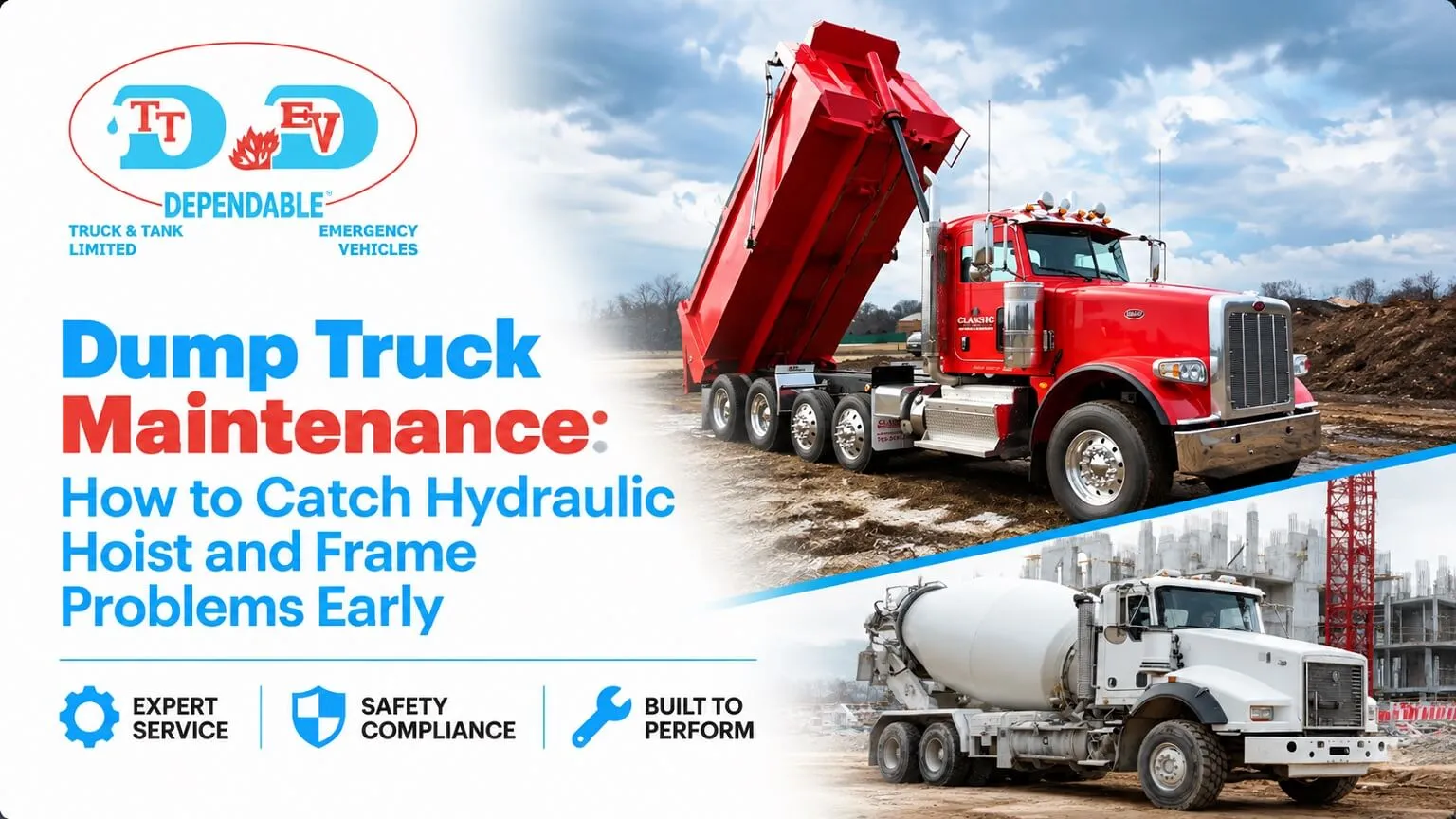
A dump truck spends almost all of its life as an ordinary truck. For about ninety seconds per load, it becomes something else entirely, a tall, top-heavy structure with its centre of gravity climbing and its full weight resting on one hydraulic cylinder and a set of hinge points.
Nearly everything that goes badly wrong on these units happens during those ninety seconds. That is why a dump truck maintenance checklist is worth more here than on most vehicles. The components that matter are the ones you cannot see while they are being tested.
The Hoist Is Doing More Than Lifting
The hoist raises the body, but it also holds it there while material slides out, while the truck sits on ground that may not be level, and while the load shifts from evenly distributed to concentrated at the back. Every part of that sequence is harder on the system than the initial lift.
The cylinder
A dump truck hydraulic cylinder fails in ways that show themselves early if anyone looks. Pitting or scoring on the chrome is the one to catch first, because a damaged rod destroys seals every time it cycles. Seal weeping, a rod that is not perfectly straight, and a body that settles slowly when held up are the other three. Drift in particular is worth acting on immediately, since a cylinder that cannot hold position is telling you it will not hold position at the worst moment.
The pump
A dump truck hydraulic pump works in short, heavy bursts rather than continuously, which makes contamination and aeration its main enemies. Slower lift times, a change in noise, and fluid running hotter than normal for that unit are the signals. Fluid that looks milky has water in it, and fluid that smells burnt has been running hot for a while.
The PTO
The dump truck pto engages and disengages many times a day, which is a different kind of wear from a unit that runs continuously. Watch for difficulty engaging, noise under load, and leaks around the mounting. Because it bolts to the transmission, problems here get expensive in a hurry.
All three share the same fluid, so hydraulic system repair and maintenance done at intervals protects the whole chain rather than one component. Fluid and filter changes, hose inspection where lines run near hinge points, and cylinder condition checks are the core of it.
Where Frames Actually Crack
Frame cracking is the failure fleet owners fear most and inspect least, partly because the places it starts are awkward to see.
Look at the hinge points at the rear of the frame, the hoist mounting, and the subframe where the body attaches. Cracks begin at stress concentrations, which usually means the end of a weld, a bolt hole, or a point where something was added to the frame at some stage in its life. Paint that has cracked in a straight line, rust weeping from a seam, or a hairline you can feel with a fingernail are all worth a proper look.
The cause is usually twisting rather than weight. Dumping on uneven ground puts a torsional load through the frame that it was not designed to take repeatedly, and loading unevenly does something similar. A driver who habitually dumps on a slope is doing more damage than one carrying heavier loads on level ground.
The same forces travel into the running gear, which is why suspension and steering repair and drivetrain services belong in the schedule for these units rather than being left until something is obviously wrong.
The Parts Everyone Forgets
Body and tailgate pivot pins wear oval, and worn pins let the body sit crooked, which loads the hoist unevenly. Floor wear is normal and worth measuring rather than guessing at, particularly on units hauling rock. Tailgate latches take abuse and get ignored until one is not released.
A dump truck tarp system is the item most likely to be running in a broken state right now, because a truck with a failed tarp still drives. Motors, springs, arms, and the tarp itself all wear, and covering the load is what keeps material from leaving the box on the highway. Keeping a few heavy-duty truck parts and components on the shelf for the items that fail often is cheaper than a unit standing idle waiting for a spring.
Configuration Changes: What Wears
A single axle dump truck is the lightest of these and the most forgiving, but it is also the one most likely to be overloaded, since the temptation is to treat it as bigger than it is.
A tandem dump truck carries more and puts proportionally more stress into the frame and suspension. A tri-axle dump truck adds a lift axle, which brings its own air system, controls, and tire wear pattern, and which only protects the rest of the truck if the driver actually uses it correctly.
An end dump truck running as a tractor and trailer combination is the least stable of the group when raised, because the body is taller and the connection between units adds another variable. Ground condition matters more for these than for any other configuration.
Two Hazards Maintenance Cannot Fix
Both happen with the box up, and neither is a maintenance failure in the ordinary sense.
Overhead power lines are the first. A raised body reaches a height the driver never thinks about while driving, and contact does not require touching the line. Nova Scotia’s Occupational Safety General Regulations set minimum approach distances by voltage, and they are not small. Three metres for lines between 750 and 69,000 volts, five metres between 69,000 and 138,000, and six metres above that. The province’s guidance on the electrical provisions sets out how those distances apply on a work site.
The habit that prevents it is simple and worth enforcing. Look up before raising, every time, and confirm the body is fully down before the truck moves off the site.
Soft or uneven ground is the second. A raised body concentrates weight rearward at the same moment the centre of gravity is highest, so ground that felt solid driving in can let one side settle while the box is up. Checking the surface before raising costs nothing and prevents the kind of rollover that ends a truck.
Common Mistakes Fleet Owners Make
- Inspecting the hoist only when it misbehaves. Cylinder pitting and slow drift both give weeks of warning.
- Never looking at the frame near the hinge points. That is where cracks start, and it is the area nobody checks.
- Treating uneven dumping ground as a driver preference. It is a structural load on the frame every time it happens.
- Running with a broken tarp system. The truck still works, which is exactly why it stays broken.
- Ignoring worn pivot pins. A body sitting crooked loads the hoist unevenly and shortens its life.
- Raising without looking up. Power line contact is the failure that does not give you a second chance.
Dump Truck Maintenance Checklist for Daily and Weekly Use
Daily, before the truck leaves:
- Check hydraulic fluid level and look for leaks at the pump, cylinder, and hose connections.
- Inspect the visible portion of the cylinder rod for pitting, scoring, and weeping seals.
- Confirm the tarp system operates through its full travel.
- Check the tailgate latches release and secure properly.
- Confirm the body is fully down and the PTO disengaged before moving off.
Weekly, with the body raised and safely supported:
- Inspect frame rails, hinge points, hoist mounting, and subframe for cracks and cracked paint lines.
- Check body and tailgate pivot pins for wear and play.
- Grease all pivot points on the schedule the manufacturer specifies.
- Time a full raise and compare it against what is normal for that unit.
- Check the body for drift by holding it raised and watching for settlement.
- Inspect floor and sidewall wear, and measure rather than estimate on rock haulers.
50+ Years of Trusted Heavy-Duty Truck Repair Experience in Nova Scotia
For more than 50 years, Dependable NS has helped fleet operators across Nova Scotia keep their heavy-duty trucks reliable, safe, and ready for the road. Our experienced team provides professional heavy-duty truck repair services, including engine diagnostics, mechanical repairs, hydraulic system servicing, inspections, and specialized equipment maintenance. Built on decades of hands-on expertise and industry knowledge, Dependable NS focuses on quality workmanship, preventative maintenance, and dependable solutions that reduce downtime and support the long-term performance of commercial fleets.
Catch It While the Box Is Down
Everything on that list is a five-minute job in the yard and a very expensive one on a site. The pattern with dump trucks is consistent: the failures are dramatic, but the warnings are dull, and they arrive early.
Dependable NS services dump trucks and vocational fleets across Nova Scotia and Atlantic Canada, covering the chassis and the mounted equipment in the same shop. If a hoist is slowing down, a body is sitting crooked, or you want a frame looked at properly, get in touch.
Frequently Asked Questions
Why is my dump body rising slowly?
Usually the hydraulic system rather than the body. Low or contaminated fluid, a worn pump, a restriction in the circuit, or air in the system all slow the lift. Compare the raise time against what is normal for that unit, because gradual change is easy to miss.
What does it mean if the body settles while raised?
The cylinder is not holding position, which normally points to internal seal failure or a valve issue. Treat it as urgent. A hoist that drifts under no load is not one to trust with a load or with someone working underneath.
Where do dump truck frames usually crack?
At stress concentrations near the rear hinge points, the hoist mounting, and the subframe, and often at the end of a weld or around a bolt hole. Cracked paint in a straight line and rust weeping from a seam are the early signs.
Does a dump truck need MVI inspection services like any other truck?
Yes. It is subject to the same daily trip inspection and the same periodic mechanical inspection as any commercial vehicle of its weight. The hoist and body are additional things to maintain, not a replacement for the standard requirements.
Who is responsible for maintenance on a dump truck rental?
Check the agreement, but the carrier operating the vehicle is responsible for the daily trip inspection and for not operating it with a major defect, regardless of who owns it. Before taking a rental, inspect the cylinder rod, check for frame cracks near the hinge points, and test the hoist through a full cycle.
How often should hydraulic fluid be changed?
Follow the manufacturer’s interval, and treat it as a minimum rather than a target for units working in dust or hauling wet material. Contamination does more damage to these systems than hours alone.
Is PTO installation and repair different on a dump truck?
The principle is the same, but the duty cycle is not. A dump truck PTO engages and disengages constantly through the day rather than running continuously, so wear shows up in engagement difficulty and noise under load before anything fails outright.
Can I inspect the frame myself?
You can look, and you should. Anything you find that looks like a crack needs proper assessment before the truck works again, since frame repair is structural work and a bad repair creates a new stress point rather than removing one.