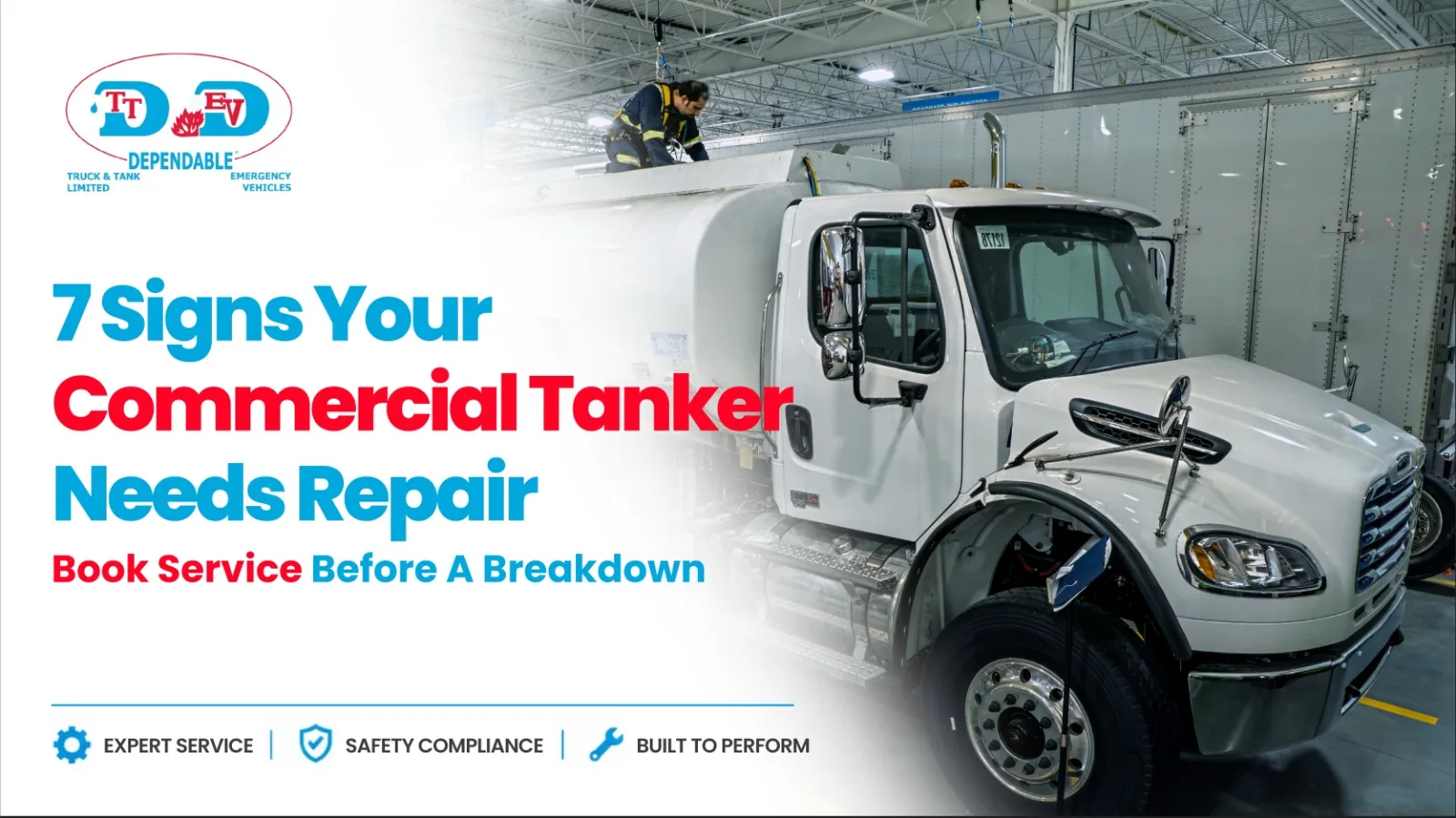
A tanker rarely fails without warning. Leaks, cracks, corrosion, and sticky valves often appear well before a load is lost. Recognising these tanker truck repair warning signs early can help turn an unexpected emergency into routine maintenance and prevent costly downtime.
Tankers carry fuel, chemicals, and gases that put constant demands on their components. Even a small defect can lead to a spill, a failed inspection, or a trailer being taken out of service.
This guide covers seven common warning signs found on tankers across Atlantic Canada, explaining their likely causes, urgency, and the appropriate repair steps
Why Commercial Tankers Wear Faster in Atlantic Canada
Tankers work harder than most trailers. Every load cycle flexes the shell, heads, and mounts. Product surge pushes against baffles and bulkheads during braking and turns. Temperature swings expand and contract seams, gaskets, and fittings.
Atlantic Canada adds salt and moisture to that stress. Environment and Climate Change Canada publishes a Code of Practice for the Environmental Management of Road Salts. It reflects how heavily Canadian roads rely on salt each winter. That salt clings to tank fittings, saddles, and crossmembers for months.
Coastal humidity then keeps metal damp long after the roads dry. Aluminum, carbon steel, and stainless steel tanks each react differently. Aluminum forms white, powdery corrosion. Carbon steel rusts and scales. Stainless steel can show brown staining and pitting where salt deposits collect.
Sign 1: Leaks, Weeping, or Product Odour
Any product outside the tank is a warning. Look for wet seams, stained paint, or residue below valves, manholes, and outlets. A fuel smell around a parked trailer is just as serious as a visible drip.
Common leak sources include:
- Manhole cover gaskets and fill cover seals
- Internal valve seats and outlet caps
- Weld seams around fittings and sumps
- Piping flanges and hose adapters
Do not patch a leak with sealant or tape to finish a route. Temporary fixes can fail under pressure and hide the true source. Professional tanker leak repair services find the source, repair it properly, and confirm the fix by testing.
Leaks at seams and fittings need a proper repair, not a workaround. Our tank repair team handles leaks at seams, fittings, and valve mounts on highway tanks.
Sign 2: Cracks and Weld Failures
Cracks usually start at stress points. The most common locations include:
- Head-to-shell welds
- Baffle and bulkhead attachment points
- Ring stiffener welds
- Mounting saddles, pads, and brackets
- The upper coupler and kingpin area
Early cracks look like fine lines in paint, rust trails, or light seepage. Each load cycle can push a crack further through the metal. A hairline crack left alone can become a through-wall leak.
Crack repair on a tank shell is regulated work. It requires qualified tanker welding services, correct filler metal, and approved welding procedures. Our weld repair and pressure vessel services cover structural and pressure boundary welding.
Sign 3: Corrosion, Pitting, and Blistered Coatings
Corrosion rarely stays cosmetic. It thins the shell, weakens welds, and seizes fasteners.
Check these areas closely:
- Under mounting saddles and wear pads
- Around fittings, manholes, and vents
- The upper coupler area on tank trailers
- Crossmembers and subframe rails
- The interior of tanks hauling corrosive products
Blistered or bubbling paint often hides active corrosion underneath. A technician should open and assess any blistered area on the shell.
Tanker corrosion repair starts with measuring how much metal remains. Ultrasonic thickness readings show whether the shell still meets its minimum thickness. If it does not, the area needs a proper repair, or the tank must leave service.
Sign 4: Dents, Gouges, and Impact Damage
Tankers take hits from docks, posts, road debris, and minor collisions. Dents in the shell or heads change how the tank carries stress. Gouges remove metal and create starting points for cracks.
Pay close attention to rollover protection, rear bumpers, and valve guards. These parts protect fittings in a crash, so any damage reduces that protection.
Dent assessment on a dangerous goods tank is not a judgment call for the yard. A qualified tank inspector must decide whether the damage is acceptable or needs repair. Early assessment keeps tank trailer repair costs lower and avoids surprises at inspection time.
Sign 5: Valve, Pump, and Emergency Shutoff Problems
Valves and pumps are the moving parts of a tanker. When they fail, loading and unloading become slow, unsafe, or impossible.
Watch for these warning signs:
- Internal valves that are slow to open or close
- Remote emergency shutoffs that do not trip
- Air leaks at valve actuators
- Pump noise, vibration, or reduced flow
- Meter readings that drift from expected volumes
Emergency shutoffs deserve top priority. They are the last line of defence if a hose fails during delivery. Check their operation during pre-trip inspections, and repair any fault before the next load.
Meter drift is also a revenue problem. An inaccurate meter can short customers or give product away on every delivery. This is everyday fuel tanker repair work, and it costs far less than a failed delivery.
Pumps wear faster in high-volume delivery work. Our pump repair service keeps tanker pump systems delivering at full flow.
Sign 6: Vent and Pressure Relief Problems
Every highway tank relies on working vents and pressure relief devices. They protect the tank from overpressure during loading and vacuum during unloading.
A stuck vacuum vent can pull in a tank shell while product is pumped out. A relief device that weeps can release vapour or product. A device that sticks closed can let pressure build beyond safe limits.
Warning signs include:
- Vapour odour or hissing near vents
- Product residue around relief devices
- Shell sections that look pulled in after unloading
- Damaged or missing vent covers
Relief devices are checked as part of periodic CSA B620 work. Under CSA B620:20, test reports record the pressure at which each relief device opens and reseats.
Sign 7: Running Gear and Chassis Problems
A tanker is only as sound as the trailer carrying it. Chassis faults send stress and vibration straight into the tank and its mounts.
Look for these problems:
- Rapid or uneven tire wear
- A trailer that dog-tracks behind the tractor
- Sagging suspension or leaking air springs
- Brake or ABS warning lights
- Lighting faults and damaged landing gear
Uneven tire wear often points to axle misalignment. A misaligned trailer scrubs tires and adds side loads to the frame and tank mounts. Professional heavy-duty wheel alignment services correct axle tracking and extend tire life.
Quick Reference: Signs, Causes, and Urgency
| Warning Sign | Common Causes | Recommended Action |
| Leaks or product odour | Worn gaskets, valve seats, cracked welds | Stop loading and repair before the next trip |
| Cracks or weld failures | Fatigue at welds, brackets, and stiffeners | Remove from service for inspection |
| Corrosion or blistered coatings | Road salt, moisture, corrosive products | Book an assessment and thickness test |
| Dents or gouges | Dock strikes, debris, minor collisions | Get an inspector’s assessment before the next load |
| Valve, pump, or shutoff faults | Wear, air leaks, contamination | Repair shutoff faults before the next load |
| Vent or relief device problems | Residue, sticking, physical damage | Repair before the next load |
| Running gear problems | Misalignment, worn suspension | Book within days; treat brake faults as urgent |
What Happens During a B620 Tanker Repair
Repairs to dangerous goods tanks follow national rules. Transport Canada explains how the TDG Regulations invoke CSA B620 for tank repair, testing, and marking. Repair work must meet that standard, not just a shop’s usual practice.
A typical repair follows five steps:
- Assessment. An inspector documents the damage and reviews the metal identification plate and test history.
- Cleaning and purging. The tank is emptied, cleaned, and made safe before any hot work.
- Repair. A registered facility completes the weld or component repair using approved procedures.
- Retesting. Shell and pressure boundary repairs typically require a pressure test before return to service.
- Marking and records. Test markings and reports are updated to show the completed work.
This process separates B620 tanker repair from general shop welding. Combining tanker inspection and repair in one visit also saves a second trip to the shop.
How to Choose a Tanker Repair Shop
Searching for tanker trailer repair near me returns plenty of truck shops. Only some are registered for dangerous goods tank work. Transport Canada requires registration to manufacture, assemble, modify, repair, inspect, or test highway tanks. You can verify any shop in the registered facilities database.
Before booking, confirm these points:
- The registration covers repair functions for your tank specification.
- The shop can perform certified CSA B620 inspection and testing after the repair.
- You will receive a written report describing the work and test results.
- The shop can re-mark the tank under its own registration number.
Choose a commercial tanker repair shop that can repair, retest, and re-mark the tank in one place. The same applies to upgrades. Custom tanker fabrication and modifications also require registration for those specific functions.
Emergency Tanker Repair Canada: What to Do on the Road
Some problems cannot wait for a shop appointment. Planning for emergency tanker repair Canada situations starts before anything goes wrong.
If a serious leak or failure happens on the road, follow these steps:
- Stop safely, away from traffic, storm drains, and ignition sources.
- Shut off the engine and close valves only if it is safe to do so.
- Keep people back from the tanker and any spilled product.
- Call 911 if anyone’s safety or property is at risk.
- For dangerous goods advice, call CANUTEC, Transport Canada’s 24-hour emergency centre, at 1-888-226-8832.
- Report any environmental release through the provincial emergency line.
- Contact your repair provider to arrange recovery and repair.
Keep these numbers posted in every cab. Drivers should never have to search for them during an emergency.
Preventive Habits That Reduce Tanker Repairs
Consistent fuel tanker truck maintenance catches most of these signs early. Build these habits into your fleet routine:
- Complete a full walk-around before every trip.
- Wash tank undersides regularly during salt season.
- Test emergency shutoffs and valves on a set schedule.
- Touch up damaged coatings before corrosion spreads.
- Track every CSA B620 test date for every tank.
- Schedule trailer alignment checks at least once a year.
- Log every repair with the date, location, and work completed.
50+ Years of Trusted Heavy-Duty Truck Repair Experience in Nova Scotia
For more than 50 years, Dependable NS has helped Nova Scotia fleet operators keep their trucks and tankers safe and reliable. Family-owned since 1975, our Dartmouth team provides engine diagnostics, mechanical repairs, and hydraulic system servicing.
We also handle tank inspections, testing, welding repairs, and specialized equipment maintenance. Decades of hands-on experience guide every job we complete.
Our focus is quality workmanship, preventative maintenance, and dependable solutions that reduce downtime. That approach supports the long-term performance of commercial fleets across Atlantic Canada.
Conclusion: Act on the First Warning Sign
Most tanker failures announce themselves through leaks, cracks, corrosion, or faulty valves. Acting on the first sign protects your drivers, your customers, and your compliance record.
Early tank trailer repair costs less, takes less time, and keeps loads moving. Pairing every repair with certified CSA B620 inspection services keeps each tank documented and ready for the road.
Need Help With Tanker Truck Repair Warning Signs?
Don’t wait for minor tanker issues to become costly breakdowns. Book a professional tanker inspection with Dependable NS to identify potential problems, address repair needs, and keep your equipment safe and road-ready. Our team supports commercial fleets across Atlantic Canada with reliable inspection, repair, and maintenance services.
Frequently Asked Questions
What is the most common reason a commercial tanker needs repair?
Leaks at gaskets, valve seats, and weld seams are the most common issue. They often start small and grow with every load cycle.
Can any welding shop repair a cracked tanker shell?
No. Repairs to a dangerous goods tank shell must be done by a facility registered with Transport Canada for that function.
Does a tanker need testing after a repair?
Usually, yes. Repairs to the shell or pressure boundary typically require a pressure test and updated markings before the tank returns to service.
How does road salt damage a tanker?
Salt holds moisture against the metal and speeds up corrosion. It attacks fittings, saddles, crossmembers, and the area under the upper coupler.
What should a driver do if a tanker leaks on the road?
Stop safely, keep people back, and call 911 if anyone is at risk. Call CANUTEC for dangerous goods advice, then report any environmental release.
How often should tanker trailer alignment be checked?
Check alignment at least once a year and after any suspension repair. Uneven tire wear between checks is a sign to book one sooner.