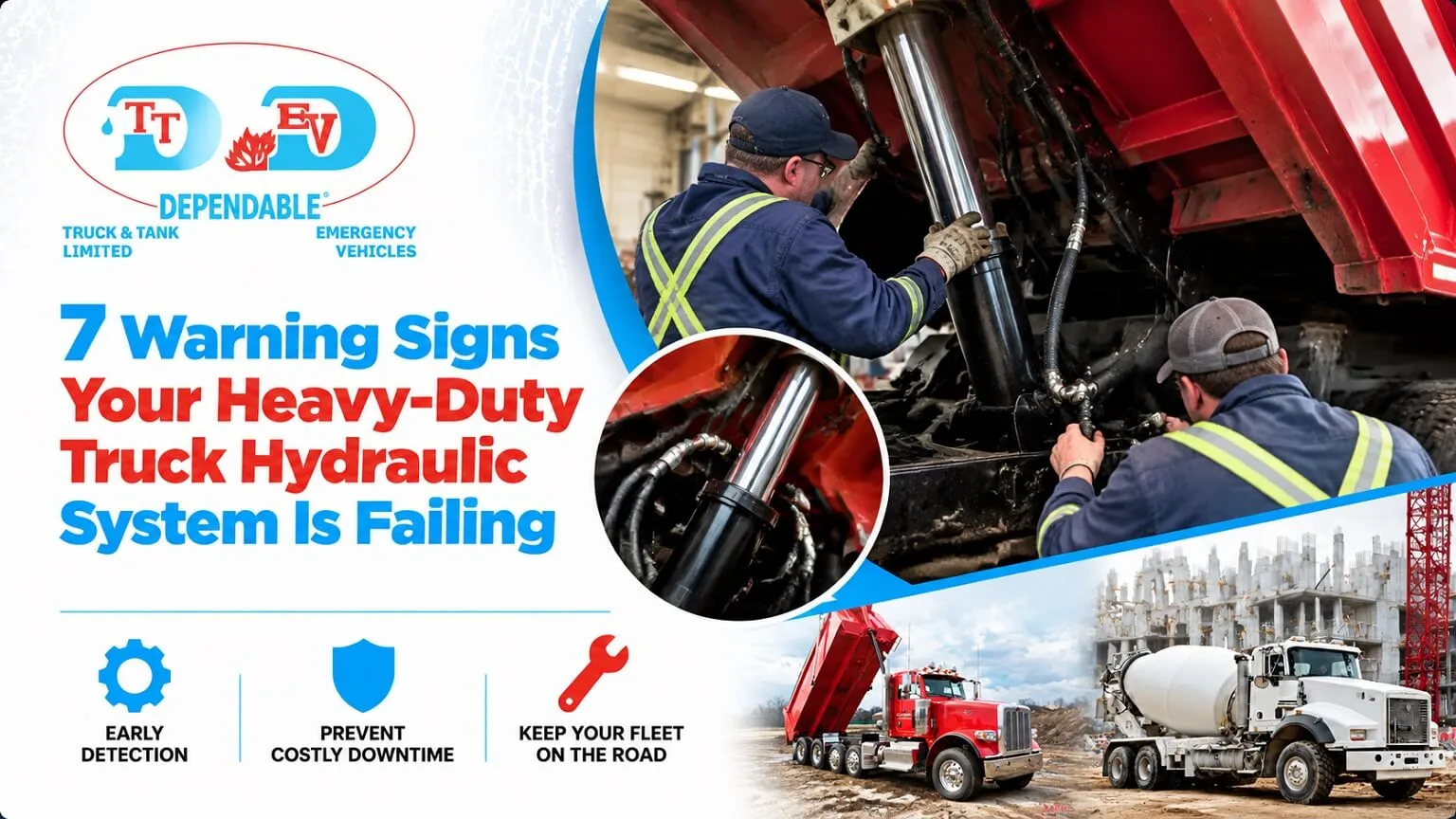
Most heavy-duty truck hydraulic problems give a warning days or weeks before a breakdown. Watch for pump whine, slow or jerky lifting, visible oil leaks, and overheated fluid. Also watch for cylinder drift, cloudy or dark oil, and a power take-off that will not stay engaged. Any one of these means the system needs an inspection before the next load.
A hydraulic failure rarely happens without warning. It usually happens after a warning that somebody drove past.
Our Dartmouth technicians service dump bodies, hoists, vacuum systems, and product transfer pumps every week. Trucks that arrive on a tow truck almost always show symptoms first. Trucks that arrive for a scheduled repair usually caught that same symptom two weeks earlier.
This guide covers the seven hydraulic system failure signs our technicians see most often. For each one, you get the symptom, the likely cause, and how urgent it is. You will also find a troubleshooting order, a maintenance schedule, and a severity guide.
What Causes Hydraulic Failure in Heavy-Duty Trucks?
Four things damage hydraulic systems: heat, contamination, air, and wear. Almost every failure traces back to one of them.
- Heat degrades the oil and hardens the seals.
- Contamination scores pump and cylinder surfaces.
- Air causes cavitation, foaming, and erratic movement.
- Wear opens internal clearances and bleeds off pressure.
Atlantic Canada adds two more pressures. Road salt and brine attack fittings, rod chrome, and hose ferrules all winter. Cold oil is also thick, which can starve the pump inlet during the first minutes of operation.
Salt use on Canadian roads is widespread. Environment and Climate Change Canada publishes a Code of Practice for the Environmental Management of Road Salts. It was issued under the Canadian Environmental Protection Act, 1999. For truck owners, that salt means faster corrosion on every exposed hydraulic part.
Sign 1: Is Your Hydraulic Pump Whining, Growling, or Knocking?
Noise is the earliest and most reliable of all hydraulic pump failure symptoms. A healthy gear pump under load has a steady hum. Anything sharper deserves attention.
A steady, high-pitched whine usually points to cavitation. The pump is starving for oil, so vapour bubbles form at the inlet. Those bubbles then collapse violently inside the pump.
An erratic knocking or rattling noise, with foamy oil in the reservoir, usually points to aeration. Air is being drawn in through a loose suction fitting, a cracked inlet hose, or a low reservoir.
Common causes include:
- Reservoir oil level below the sight glass minimum
- A plugged or collapsed suction strainer
- A loose clamp or cracked hose on the inlet side
- Oil too thick for the outside temperature
- A PTO or pump driven above its rated speed
Cavitation destroys a pump from the inside out. A failing hydraulic pump left to cavitate will shed metal through the whole circuit. That turns a pump replacement into a full system flush.
Pumps on tank units face the same inlet and wear problems. Our pump repair team works on tanker and product transfer pumps across Nova Scotia.
Sign 2: Why Is Your Dump Body Lifting Slowly or Stalling Halfway?
Slow lift is the most common complaint we hear on dump and tank units. It is also the clearest sign of truck hydraulic pressure loss.
The body should rise smoothly at a consistent rate. If it lifts fine empty but stalls loaded, the system is no longer making rated pressure.
Many dump hoist relief valves are set between roughly 2,000 and 3,000 psi. The correct figure for your truck comes from the hoist manufacturer, not a general range. A gauge reading below spec confirms the problem. Guessing does not.
Here is how common dump body lifting problems usually break down:
| Symptom | Likely Cause | Where to Check First |
| Lifts empty, stalls loaded | Worn pump or low relief setting | Pressure test at the pump outlet |
| Slow and steady throughout | Internal pump wear or a bypassing valve | Flow test, then relief valve |
| Jerky or stepped movement | Air in the circuit or low oil | Reservoir level and suction side |
| Lifts, then creeps back down | Cylinder seal or holding valve leak | Cylinder and control valve |
| No movement at all | PTO not engaged or sheared pump shaft | PTO engagement and pump drive |
Many dump truck hydraulic system problems get expensive because operators hold the control lever over relief. That sends full pump flow across the relief valve and turns pressure straight into heat.
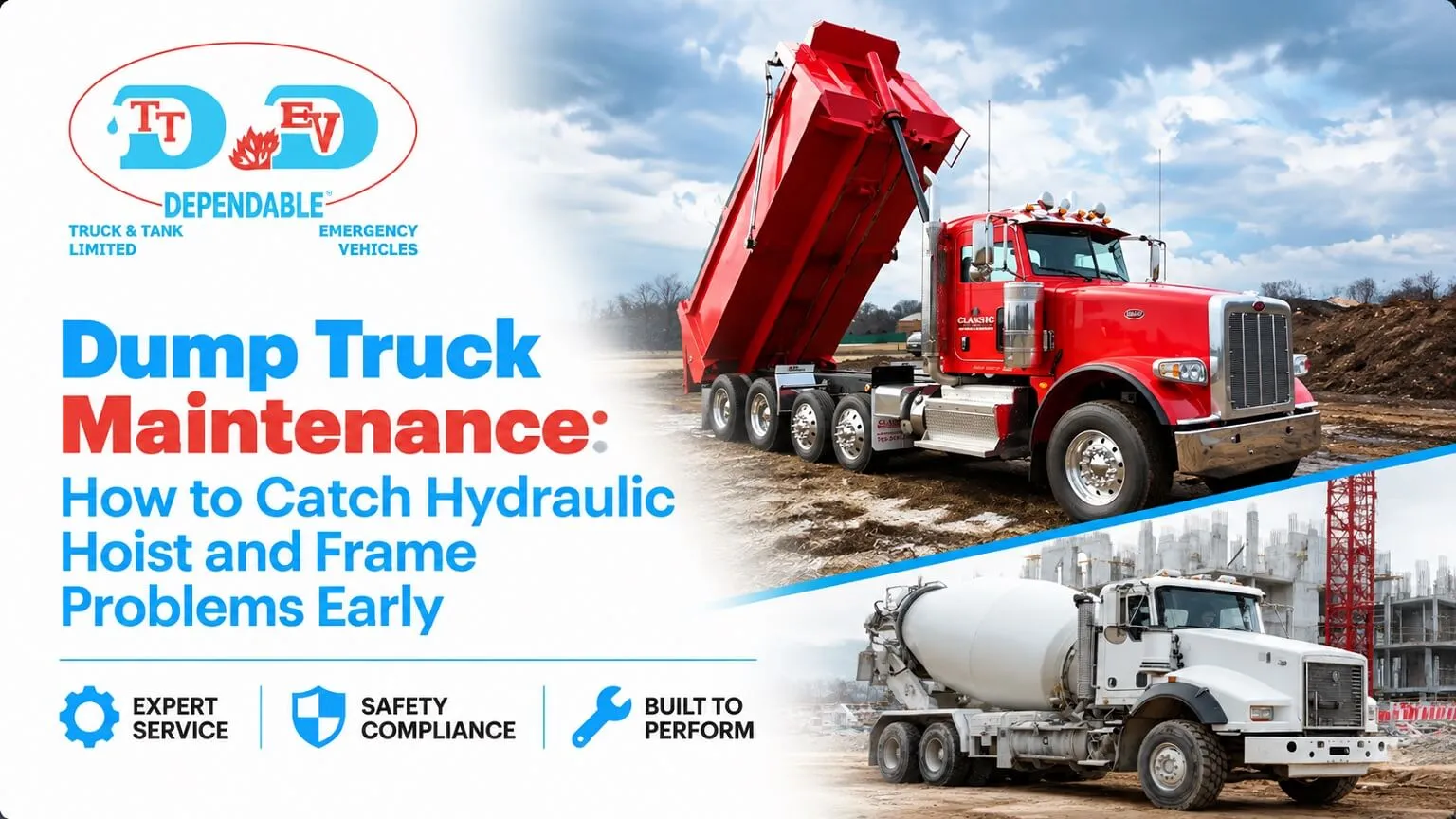
Hoist trouble often shows up alongside frame and body wear. Our dump truck maintenance guide explains how to catch hoist and frame problems early.
Sign 3: Is There a Hydraulic Hose Leak on Your Truck?
A hydraulic hose leak on a truck usually starts small. It shows up as a damp fitting, a dust-caked stripe on a hose, or fresh drips below. Check the condition on every pre-trip. Look for cracked covers, exposed wire braid, kinks, blisters, and hoses rubbing on frame rails.
SAE J1273 is the industry’s recommended practice for hose selection, routing, installation, and inspection. Shops should work to it when replacing a line. It is also worth handing to every new technician.
Safety note: never search for a leak with your hand. Fluid escaping a pinhole at roughly 100 psi or more can penetrate skin. An injection injury is a surgical emergency, even when it looks like a small puncture. Use a piece of cardboard to find the leak, and wear eye protection. If an injection injury happens, go to the hospital immediately and bring the fluid’s safety data sheet.
Leaks are not only a maintenance issue. Oil reaching brake components or a hot exhaust is a fire and safety hazard. Nova Scotia’s daily trip inspection requirements are designed to catch defects like these before a truck leaves the yard. The province adopted National Safety Code Standard 13 for trip inspections on February 13, 2018.
A large spill is also an environmental issue. A significant hydraulic oil release onto the ground or near water should be reported through Canada’s environmental emergency reporting line.
Sign 4: Is Your Hydraulic Fluid Running Too Hot?
Heat is the quiet cause behind many heavy-duty truck hydraulic problems. Most mobile hydraulic systems run best between roughly 40°C and 60°C.
Above about 82°C, oxidation speeds up sharply, and seals begin to harden. A common field rule says oil life roughly halves for every 10°C of sustained operation above 60°C.
Hot oil also thins out. Thin oil slips past internal clearances, which drops pressure. The operator then holds the lever longer, which creates even more heat. That loop is why an ignored overheating complaint often ends in pump failure.
Signs the system is running hot:
- The reservoir is too hot to keep a hand on.
- Varnish or lacquer stains appear on the dipstick or reservoir walls.
- A burnt or sharp smell comes from the reservoir cap.
- Hardened, cracked seals keep failing at the same cylinder.
Check the reservoir level, cooler airflow, and relief valve setting. Also check operator habits. Holding a lever on relief after the body is fully raised adds heat fast. It is one of the most common causes we find.
Sign 5: Does the Body or Cylinder Drift Down After You Stop?
Cylinder drift is one of the clearest hydraulic cylinder failure symptoms. A raised body should hold its position. If it settles on its own, oil is passing somewhere it should not.
The leak is either internal or external. Internal drift means worn piston seals or a holding valve that no longer seats. External drift is easier to spot. You will see oil weeping past the rod wiper or a wet gland nut.
Inspect the rod closely. Score marks, pitting, and flaking chrome tear new seals as fast as you install them. Winter salt is hard on exposed rod chrome. Spring is often when that damage finally shows up as leaking rod seals.
Protecting the chassis helps too. Our truck undercoating service helps shield frame rails and underbody parts from salt and moisture.
Safety note: never work under a raised body that relies on hydraulics to hold it. Use the body prop every time.
Sign 6: What Is Your Hydraulic Fluid Telling You?
Pull the dipstick or check the sight glass every week. Fluid appearance is free diagnostic data, and most fleets ignore it.
| Fluid Appearance | What It Usually Means | Action |
| Clear, amber, no odour | Healthy oil | Continue normal intervals |
| Milky or cloudy | Water above the oil’s saturation point, often a few hundred ppm | Find the entry point, then change fluid |
| Dark brown or black | Thermal breakdown and oxidation | Find the heat source, then change fluid |
| Foamy or bubbly | Air entering on the suction side | Check level, inlet fittings, and seals |
| Gritty or metallic sheen | Pump or cylinder wear | Stop use, sample, and flush |
| Varnish film on parts | Sustained overheating | Inspect cooler and relief valve |
Cleanliness is measurable, not a judgment call. ISO 4406 sets the particle count code used on oil analysis reports. Many gear pump systems target a code around 18/16/13. Piston pump systems need cleaner oil, so confirm the target with your component manufacturer.
Coastal humidity is a real factor in Nova Scotia. Trucks parked outdoors draw moist air through the breather as the oil heats and cools. A plugged or missing breather filter makes the problem worse.
Sign 7: Is Your Power Take-Off Slipping, Chattering, or Refusing to Engage?
The power take-off system is where many “hydraulic” complaints actually start. No PTO engagement means no pump drive. No pump drive means nothing moves.
Watch for these PTO warning signs:
- Grinding or gear clash when engaging
- Engagement that drops out under load
- A gear whine that changes with engine speed
- An air leak at the shift cylinder on air-shift units
- A leaking gasket where the PTO mounts to the transmission
On manual transmissions, most PTOs should be engaged at idle with the clutch fully disengaged. On automatic transmissions, follow the PTO and transmission makers’ engagement procedure. Engaging at high RPM damages gear teeth and shortens the unit’s life.
A leaking PTO mounting gasket drains transmission oil. Left alone, it can turn a small gasket repair into a transmission failure.
Correct setup matters from day one. Our PTO installation service helps make sure the PTO, pump, and truck are matched correctly.
How to Carry Out Hydraulic System Troubleshooting Safely
Good hydraulic system troubleshooting follows a set order. Do the cheap checks first and the expensive diagnostics last.
- Confirm the complaint. Run the system yourself. Note whether the symptom appears loaded or empty, cold or hot.
- Check the oil. Look at level, colour, smell, and temperature before touching a tool.
- Inspect the suction side. Most noise complaints are solved at the strainer, inlet hoses, and clamps.
- Walk the circuit. Trace every hose and fitting for damp spots, wear points, and damage.
- Verify PTO operation. Confirm it engages fully and holds under load.
- Pressure test at the pump. Compare the reading against the manufacturer’s spec.
- Flow test if pressure is normal but speed is not. A pump can build pressure and still fall short on volume.
- Isolate the cylinder. Cap and block the line to separate cylinder bypass from valve bypass.
Before opening any line, lower the body fully and relieve all stored pressure. Trapped pressure can remain in a circuit long after the engine is off.
What Does Preventive Hydraulic Maintenance for Fleets Look Like?
Reactive repair costs more than parts. It costs the load, the driver’s day, and the customer’s schedule. Preventive hydraulic maintenance for fleets is one of the cheapest line items on the whole truck.
| Interval | Task |
| Every pre-trip | Oil level, visible leaks, hose condition, PTO engagement |
| Weekly | Fluid appearance, reservoir temperature after a shift, breather condition |
| Monthly | Full hose and fitting inspection, cylinder rod condition, mounting hardware torque |
| Quarterly or 250 hours | Filter change, pressure check, cooler cleaning |
| Annually or 1,000 hours | Oil analysis, fluid change, relief valve check, full circuit inspection |
Treat these intervals as a starting point. Your hoist, pump, and PTO manufacturers publish their own schedules. Duty cycle matters too. A salt and brine unit running all winter needs tighter intervals than a seasonal gravel truck.
Two habits pay for themselves quickly. First, log every fluid and filter change with the date and hours. Second, sample the oil at least once a year. Oil analysis flags wear metals long before you hear a noise.
Periodic inspections add another checkpoint. Nova Scotia’s Motor Vehicle Inspection program uses the national periodic inspection standard for commercial vehicles. Scheduling hydraulic checks before inspection dates helps avoid surprise repairs.
Fleets that formalize commercial truck hydraulic maintenance this way replace pumps on a schedule, not on the shoulder.
Which Hydraulic Problems Can Wait, and Which Cannot?
Not every symptom means parking the truck. Some do.
| Severity | Symptom | Response |
| Park it now | Injection risk, spraying leak, or body drops under load | Out of service, tow if required |
| Park it now | Loud cavitation with metal in the oil | Stop before debris spreads through the circuit |
| Schedule this week | Slow lift under load with confirmed pressure loss | Book service before the pump fails |
| Schedule this week | Cylinder drift or a weeping rod seal | Rebuild before the rod scores |
| Monitor and book | Damp fitting, minor seepage, or a small temperature rise | Inspect at the next PM service |
When in doubt, ask one question. Could this fail while the body is raised or while the truck is in traffic? If yes, it is not a next-month repair.
50+ Years of Trusted Heavy-Duty Truck Repair Experience in Nova Scotia
For more than 50 years, Dependable NS has helped Nova Scotia fleet operators keep heavy-duty trucks safe and reliable. Family-owned since 1975, our Dartmouth team provides engine diagnostics, mechanical repairs, and hydraulic system servicing.
We also handle inspections, tank work, and specialized equipment maintenance. Decades of hands-on experience guide every job.
Our focus is quality workmanship, preventative maintenance, and practical solutions that reduce downtime. That approach supports the long-term performance of commercial fleets across Atlantic Canada.
Conclusion:
Every one of these seven signs is visible or audible before it becomes a breakdown. Fleets that stay running are not always the ones with newer trucks.
They are the ones whose drivers know what to look for and report it early. Most heavy-duty truck hydraulic problems are cheaper to fix this week than on the shoulder of Highway 102.
Professional hydraulic system repair combined with routine heavy-duty vehicle servicing keeps small leaks and slow lifts from becoming tows.
Seeing any of these warning signs?
Call Dependable NS at 902-334-7800 or book a hydraulic inspection today. Our team offers 24/7 support for breakdowns. For more maintenance advice, explore our blog guides on dump trucks, engines, and suspension systems.
Frequently Asked Questions
What are the first hydraulic system failure signs on a dump truck?
Slow lifting under load and a change in pump noise usually come first. Both appear well before a hard failure. Both are easy to check during a pre-trip.
How do I know if my hydraulic pump is failing?
A failing pump usually shows rising noise, slower cycle times, and higher oil temperature together. A pressure and flow test at the pump outlet confirms it.
Can I keep driving with a small hydraulic leak?
A small external leak is not automatically an out-of-service defect. It can become one quickly. Oil reaching the brakes, the exhaust, or the road is a safety and inspection problem. Book the repair instead of topping up the reservoir.
Why is my hydraulic oil milky?
Milky oil means water has entered the system. Common sources are a failed breather, a damaged reservoir cap, or condensation in trucks parked outdoors. Water reduces lubrication and speeds up corrosion. Find the entry point before changing the fluid.
How often should hydraulic fluid be changed on a commercial truck?
Many fleets change it annually or around 1,000 operating hours. The manufacturer’s interval and your duty cycle should govern. For high-hour units, oil analysis is a better guide than the calendar.
Do truck hydraulic systems have more problems in winter?
Yes. Cold oil is thick and can starve the pump inlet at start-up. Road salt also attacks fittings, hoses, and rod chrome. Let the system warm up at low load before the first full lift of the day.