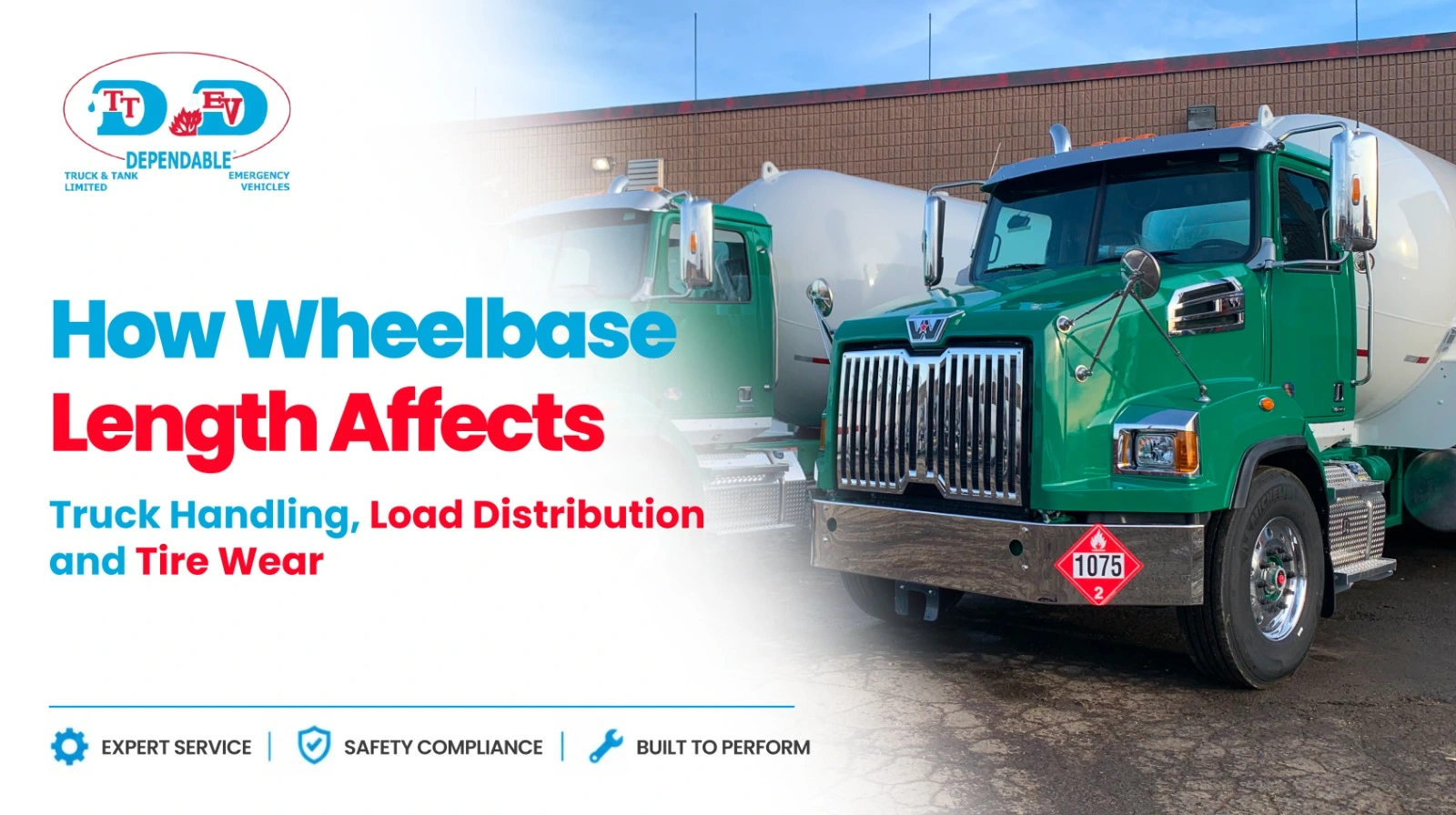
A truck’s wheelbase is the distance from the centre of the front axle to the centre of the rear axle. In tandem, it is measured to the midpoint between the two rear axles. That one dimension controls how the truck turns, how weight lands on each axle, and how evenly tires wear.
When a chassis is stretched, shortened, or fitted with the wrong body, predictable truck wheelbase problems follow. The most common are overloaded axles, unstable handling, and tires that wear out early.
This guide explains how wheelbase affects each of these areas. It also covers the warning signs of a mismatch and the safe ways to correct one.
What Is a Wheelbase, and Why Does It Matter for a Work Truck?
Every truck is engineered around a specific wheelbase. The manufacturer sets it to spread the weight of the cab, frame, fuel, and payload across the axles. Each axle must stay within its gross axle weight rating (GAWR).
Body builders also work with a second dimension called cab-to-axle, or CA. CA is the distance from the back of the cab to the rear axle centreline. Together, the wheelbase and CA decide how long a body can be and where its weight will sit.
Adding a service body, tank, crane, or aerial device changes that balance. The wheelbase either still suits the new weight and axle position, or it does not.
Why Commercial Vehicle Upfitting Starts With the Wheelbase
Commercial vehicle upfitting is never just a matter of bolting a body onto a chassis. The upfitter must confirm the body’s centre of gravity sits in the right place relative to the axles. If that step is skipped, handling and wear problems are built into the truck from day one.
Federal rules also apply to alterations. Section 9 of the Motor Vehicle Safety Regulations covers companies that alter a compliant vehicle. Those companies must keep the original compliance label and respect the manufacturer’s GAWR and GVWR.
Ratings can only rise in line with the manufacturer’s written recommendations or component capacity. The company must also add a label identifying who altered the vehicle. These rules mainly apply before a vehicle’s first retail sale, but they set a sound standard for every upfit.
Planning a new build properly avoids most of these issues. A well-planned custom truck and tank build considers payload, body length, and axle ratings before any steel is cut.
How Wheelbase Length Changes Handling
Wheelbase length is a direct trade-off between manoeuvrability and stability.
A shorter wheelbase turns tighter and reacts faster to steering input. That helps in tight yards, loading docks, and urban routes. It also pitches and sways more under braking and over rough pavement.
A longer wheelbase rides smoother and tracks straighter at highway speed. It needs more room to turn. It also has less clearance when cresting steep ramps and rough job site ground.
| Wheelbase | Turning Circle | Ride and Stability | Common Use |
| Short | Tight, easier low-speed manoeuvring | More pitch and sway, rougher ride | Urban delivery, tight job sites, dump trucks |
| Long | Wide, needs more turning room | Smoother ride, better highway tracking | Highway hauling, long bodies, tankers |
Neither length is correct on its own. It must match the body, the payload, and the routes the truck actually runs. No amount of driver skill can fully make up for the wrong wheelbase.
How the Wrong Wheelbase Creates Truck Weight Distribution Problems
Wheelbase and legal axle loads are closely linked. In Canada, allowable weights depend on axle group type, the spread within each group, and spacing between groups.
Nova Scotia sets its limits in the Vehicle Weights and Dimensions regulations. A truck can be mechanically able to carry a load and still be overweight on one axle. That is one of the most common truck weight distribution problems after a body swap or used-chassis upfit.
Body builders use a simple lever calculation to predict axle loads. Multiply the payload by the distance from its centre of gravity to the rear axle centreline. Divide that by the wheelbase to get the load added to the front axle. The rest goes to the rear axle.
Here is how that plays out for a 10,000 kg payload on a 5.5 m wheelbase:
| Payload Centre of Gravity | Load Added to Front Axle | Load Added to Rear Axle |
| 1.0 m ahead of the rear axle | 1,818 kg | 8,182 kg |
| 0.3 m behind the rear axle | Minus 545 kg | 10,545 kg |
In the second case, the payload actually lifts weight off the steer axle. The rear axle carries more than the full payload, and steering grip drops.
The opposite problem is just as serious. An overloaded steer axle makes the truck feel heavy and slow to respond in corners. An overloaded rear group compresses the suspension and reduces ground clearance. It also speeds up wear on bushings, bearings, and brakes.
Wheelbase and Tire Wear: What Is the Connection?
Tires are often the first place a wheelbase problem shows up. They react to every kilogram of imbalance on every kilometre.
An axle carrying more than its rated load runs its tires hotter. Overloaded tires often wear faster on both shoulders and can suffer casing damage.
Axle position matters as much as axle load. A relocated rear axle that is not square to the frame creates a thrust angle. The truck then dog-tracks, pulls, and scrubs its steer tires.
The wheelbase also changes turning behaviour. For the same turning circle, a longer wheelbase needs more steering angle. Long tandem trucks also scrub their rear tires in tight turns.
Not every wear pattern points to the wheelbase. Cupping usually traces back to worn shocks, imbalance, or loose components. Feathering usually points to incorrect toe settings. Our guide to heavy truck wheel alignment explains how alignment affects tire life.
Correcting truck wheelbase issues early usually costs far less than replacing tires twice as often.
Common Signs of a Wheelbase Mismatch
Watch for these warning signs, especially after an upfit or a used-chassis purchase:
- Rapid or uneven tire wear on one axle
- The truck pulling to one side or dog-tracking
- Instability in crosswinds or on uneven pavement
- Excessive body roll or sway when cornering
- A steer axle or rear group that is overweight at the scale
- A harsher ride after a body, tank, or equipment install
- Suspension bottoming out under a load within the GVWR
Any one of these alone may point to alignment or suspension wear. Several together, especially after an upfit, usually point to truck wheelbase problems in the axle placement itself.
Suspension stability problems are often the earliest visible warning sign. They usually mean the wheelbase and payload were never properly matched.
Buying a Used Chassis? Check the Wheelbase First
Used chassis are a common source of wheelbase mismatches. A truck built for one body is often bought for a very different job.
Before buying, record the wheelbase, CA dimension, GAWR, and GVWR from the compliance label. Compare them with the body builder’s requirements for the body you plan to install. Weigh the truck empty on a certified scale to confirm actual axle loads.
Trucks from other provinces need extra attention. Since June 3, 2025, Nova Scotia’s interprovincial vehicle recognition rules let carriers register vehicles eligible in another Canadian jurisdiction. The vehicle must still meet Nova Scotia’s road weight limits. A wheelbase that works in one province may still create axle weight issues here.
Correcting Truck Wheelbase Issues: Frame Modification and Axle Relocation
There are two main ways to fix a wheelbase that is wrong for the job. You can change the frame length, or you can change where the axle sits. Both fall under truck frame modification, and both must be planned around the truck’s duty cycle.
Truck Frame Extension or Shortening
A truck frame extension adds length between the axles. It is usually done to carry a longer body, tank, or aerial device. Shortening does the opposite and tightens the wheelbase for better manoeuvrability.
Both are structural changes, not cosmetic ones. The work should follow the chassis manufacturer’s body builder guidelines for splices and reinforcements. Many OEMs restrict welding or heating on heat-treated frame rails. Most also limit where holes may be drilled, and flange drilling is commonly prohibited.
A wheelbase change also affects systems beyond the frame. Driveshafts must be lengthened or shortened, and longer drivelines may need an added centre bearing. Air lines, ABS sensor wiring, fuel lines, and exhaust may also need rerouting.
Truck Axle Relocation
Sometimes the frame length is fine, but the axle sits in the wrong place. Truck axle relocation moves the axle forward or back to restore safe weight distribution. It is often the more targeted fix after a body swap. The relocated suspension must be mounted square to the frame and checked for thrust angle afterward.
Tank units raise the same question when a tank moves to a new chassis. Tank modifications and remounts should always include a check of axle loads and wheelbase fit.
This is the work that separates proper commercial truck chassis modification from a workaround. Custom truck fabrication done to specification engineers the frame stress, axle spacing, and weight distribution. That keeps the truck legal, stable, and easy on tires for its whole service life. Done right, heavy-duty truck customization adds capability without adding risk.
Why Wheelbase Work Needs Qualified Structural Welding Services
Frame and axle work sits at the safety-critical end of heavy-duty truck frame repair. A rail welded without the right prep, filler metal, or joint design can be weaker than the original steel. That turns a handling problem into a structural one.
Choose a shop set up for structural welding services on commercial chassis. In Canada, many fabrication shops are certified by the Canadian Welding Bureau to CSA W47.1. Ask about welder qualifications and the welding procedure before any framework begins.
After the work, confirm the results before the truck returns to service:
- Weigh each axle loaded and empty on a certified scale.
- Complete a full alignment, including rear axle thrust angle.
- Inspect welds, fasteners, and crossmembers after the first few hundred kilometres.
- Update the vehicle labels if any weight ratings have changed.
Nova Scotia’s Motor Vehicle Inspection program sets the periodic inspection standard for commercial vehicles. After major frame work, many fleets book an inspection at an official MVI station before the next job.
How Preventive Fleet Maintenance Catches Wheelbase Problems Early
It is worth catching wheelbase-related wear before it becomes a full correction job. Preventive fleet maintenance should include axle weight checks, tire wear reviews, and suspension inspections. These checks often flag a load distribution problem before any driver complaint.
Scale every truck after any body, tank, or equipment install. Record tread depth and wear patterns at each PM service. Inspect springs, air bags, bushings, and shocks for signs of overload.
Regular heavy-duty vehicle service ties these findings together. Our guide to heavy truck suspension and steering maintenance covers the components that show overload first.
Conclusion: Getting the Wheelbase Right the First Time
Whether you are speccing a new upfit or fixing a used chassis, start with one question. Does the wheelbase match the weight it carries and the axles supporting it?
Fixing truck wheelbase problems properly is the difference between predictable handling and a truck that keeps eating tires. Professional wheelbase modification services help fleets make that correction safely and correctly.
50+ Years of Trusted Heavy-Duty Truck Repair Experience in Nova Scotia
For more than 50 years, Dependable NS has helped Nova Scotia fleet operators keep heavy-duty trucks safe and reliable. Family-owned since 1975, our Dartmouth team provides engine diagnostics, mechanical repairs, and hydraulic system servicing.
We also handle inspections, fabrication, tank remounts, and specialized equipment maintenance. Decades of hands-on experience guide every job. Our focus is quality workmanship, preventative maintenance, and dependable solutions that reduce downtime. That approach supports the long-term performance of commercial fleets across Atlantic Canada.
Planning an upfit or dealing with uneven tire wear?
Contact Dependable NS today. For more fleet advice, explore our blog guides on alignment, suspension, and dump truck maintenance.
Frequently Asked Questions
What causes wheelbase issues after a truck upfit?
Usually the body’s weight and centre of gravity do not match the chassis axle spacing. That shifts too much static weight onto the front or rear axle.
Can a short wheelbase cause tire wear?
Yes, when it is too short for the body or payload. The rear axle can become overloaded, which wears tires faster on the shoulders. It can also lift weight off the steer axle and reduce steering grip.
Is truck frame extension safe if done properly?
Yes, when it follows the chassis maker’s body builder guidelines. The work should use approved splice designs and qualified structural welders. The driveline, air lines, and wiring must also be adjusted correctly.
How do I know if my truck needs axle relocation instead of a frame change?
If the frame length suits the body but axle loads are off, relocation is usually the targeted fix. A frame change is needed when the body requires a different wheelbase than the frame allows.
Does changing the wheelbase affect my truck’s weight ratings or labels?
It can. Federal rules require companies that alter a compliant vehicle to respect the manufacturer’s GAWR and GVWR. If ratings change, the added alteration label must show the new values.
How often should fleets check for weight distribution problems?
Check axle weights and tire wear at every major service interval. Also scale the truck immediately after any body, tank, or equipment installation.